
*This article may contain affiliate links. For full information, please see the disclaimer here.
Myanmar is a place where you can find 2,000 ancient temples in a single valley and people who eat tea leaves instead of just steeping them. It’s a country that often feels like a beautiful contradiction—where the streets are filled with men in traditional wrap-around longyis and children with sun-protective thanaka paste painted on their cheeks, yet everyone is glued to a smartphone.
From the gravity-defying Golden Rock to the serene, one-legged rowers of Inle Lake, the country offers a sensory experience that is increasingly hard to find anywhere else in Southeast Asia.

So, what is Myanmar known for? Myanmar has gained global attention through the political journey of Aung San Suu Kyi and the somber history of the WWII “Death Railway,” but the nation’s true fame lies in its everyday character. It’s the shimmering diamonds atop the Shwedagon Pagoda, the complex flavors of a morning bowl of Mohinga noodles, and a local script so loopy and circular it looks more like art than an alphabet.
There’s more to Myanmar than meets the eye—and below are just some of the things that make it fascinating!
Table of Contents
What is Myanmar known for?
1. Temples of Bagan
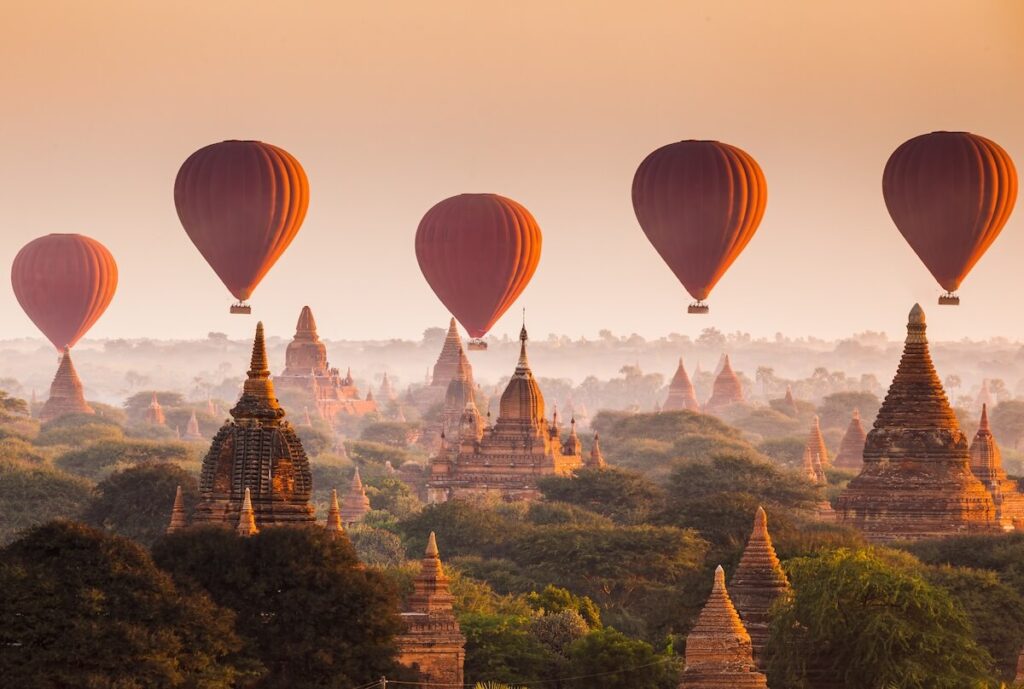
Sitting on a scenic bend of the Ayeyarwady River in central Myanmar, Bagan is a sprawling archaeological wonderland straight out of a movie set. Between the 9th and 13th centuries, this was the capital of the Pagan Kingdom (also known as the Bagan Empire)—the first empire to unify the region.
In a massive burst of religious fervor, rulers and citizens built over 10,000 Buddhist monuments across the plains. Today, around 2,200 of these brick and gold structures remain, earning the area a well-deserved spot as a UNESCO World Heritage Site.
Myanmar is famous for this “sea of temples,” easily the most recognizable image of the country, where you can find everything from the massive, fortress-like Dhammayangyi to the elegant, gold-topped Ananda. While some are grand and perfectly restored, others are hidden, crumbling gems tucked away down dusty dirt tracks.
The best way to take it all in is through this guided sunrise or sunset tour, though the most iconic view is definitely from a hot air balloon, watching the morning mist weave through the spires.
2. Shwedagon Pagoda
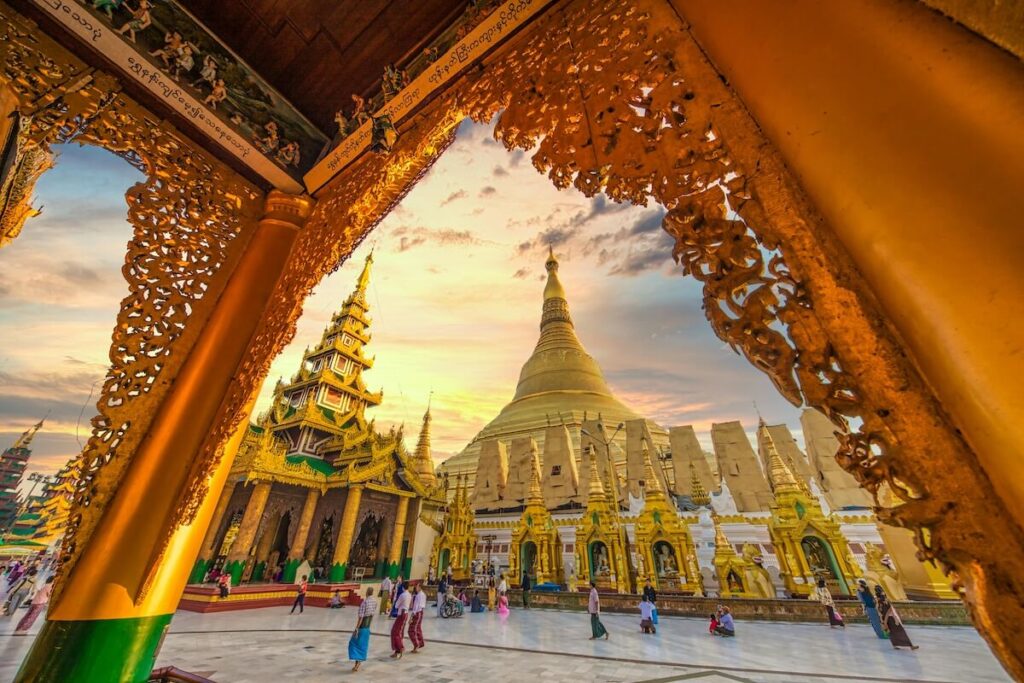
Rising 99 meters over the Yangon skyline, the Shwedagon Pagoda is a major landmark and the spiritual heartbeat of the country.
This massive, gold-plated stupa is topped with a crown containing thousands of diamonds and rubies. Legend says it’s over 2,600 years old, making it the oldest Buddhist stupa in the world. It’s a place where locals come to pray, meditate, or simply catch up with friends amidst the shimmering shrines.
For the best experience, visit at sunset when the gold glows against the darkening sky. If you want to dive deeper into the rituals and history, this half-day join-in tour covers the local traditions perfectly. It’s an essential stop for anyone trying to understand the soul of Myanmar.
3. Inle Lake and the leg-rowers
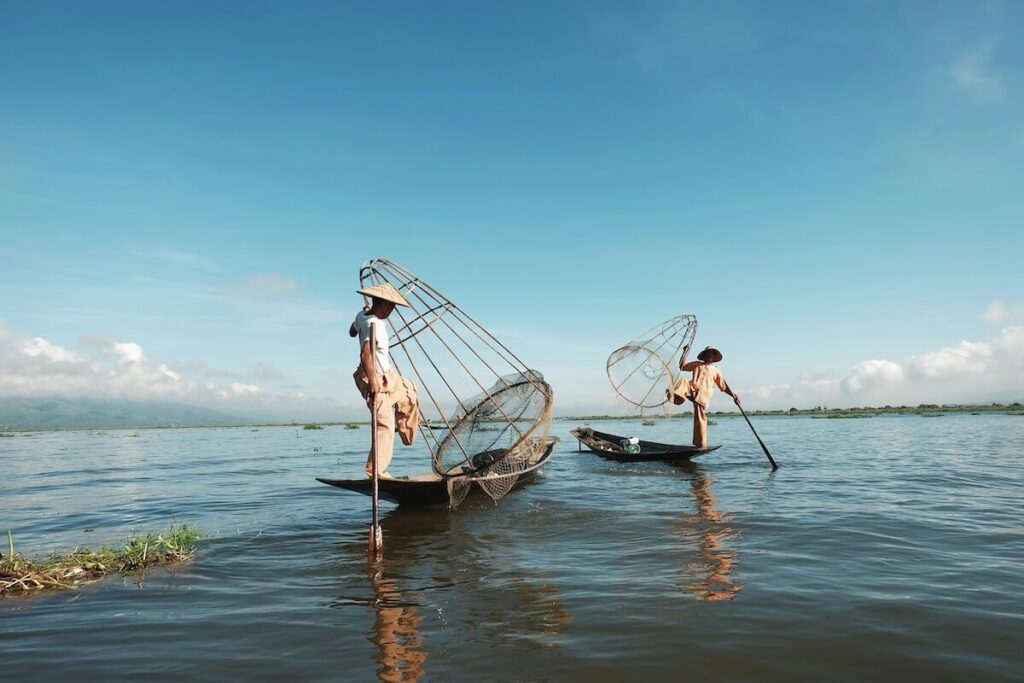
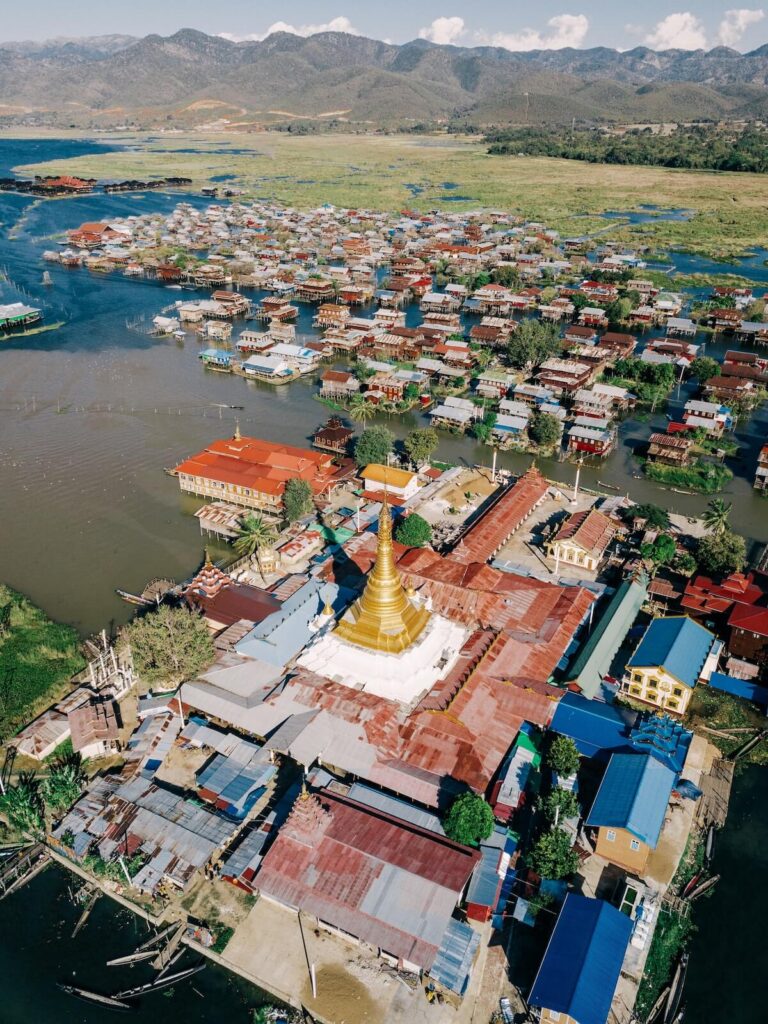
Nestled in the Shan Hills, Inle Lake is a massive freshwater expanse where life happens entirely on the water. It’s famous for the Intha people, who have built an entire civilization of floating villages and gardens.
The real stars here are the local fishermen, though. They use a one-legged rowing technique that lets them stand tall to spot fish through the reeds while keeping their hands free to manage large, conical nets. It’s a unique cultural marvel found nowhere else.
Beyond the iconic rowing, the lake is a hub for traditional crafts like silk weaving and silversmithing. You’ll find houses on stilts and “floating” tomato patches that actually drift with the current. If you visit, try to catch the five-day rotating market—it’s the best way to see the diverse hill tribes gather to trade their goods.
4. The name “Burma”

Myanmar was formerly known as Burma, a name rooted in the British colonial era. In 1989, the ruling military government officially made the switch to “Myanmar” to be more inclusive of the country’s 135 ethnic groups, rather than just the majority Bamar people. While the UN and most countries adopted the new name, others stuck with Burma for political reasons.
Today, you’ll hear both names used interchangeably, though “Myanmar” is the standard for official business and “Burmese” remains the go-to for the language and the food. It’s a fascinating linguistic quirk that reflects the country’s complex history and its ongoing journey toward a modern identity.
5. Aung San Suu Kyi

For decades, Aung San Suu Kyi was the world’s most famous symbol of peaceful resistance. As the daughter of Myanmar’s independence hero, General Aung San, she returned home in 1988 and quickly became the leader of the pro-democracy movement.
She spent nearly 15 years under house arrest, a sacrifice that earned her the Nobel Peace Prize and turned her into a global icon of courage. That said, her political journey has seen incredible highs and complex lows. After her party’s landslide victory in 2015, she served as the country’s de facto leader, though her reputation abroad became complicated over the following years.
Following a military coup in 2021, she was once again detained and remains a central, though controversial, figure in Myanmar’s ongoing struggle. Whether you view her as a saint or a politician, there’s no denying she is the most recognizable face of the nation’s modern history.
6. Thingyan
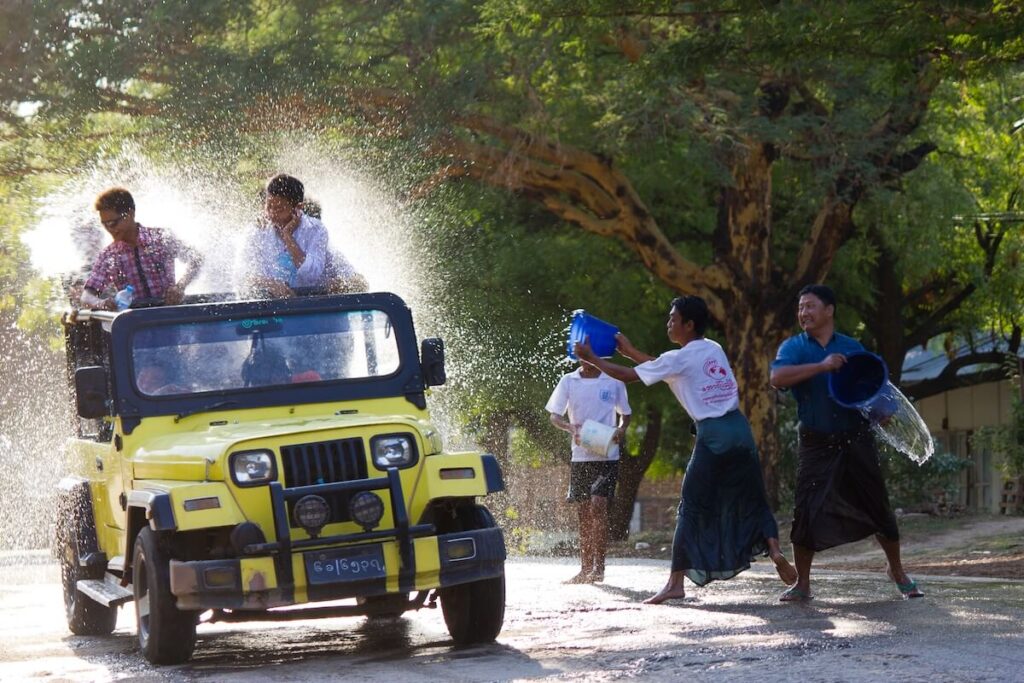
If you find yourself in Myanmar in mid-April, prepare to get soaked.
Thingyan is the Burmese New Year, a massive multi-day celebration that marks the sun’s transition from Pisces to Aries. Rooted in both Buddhist and Hindu mythology, the festival centers on the belief that water washes away the sins and bad luck of the previous year.
For several days, the entire country grinds to a halt as people of all ages take to the streets for the world’s most enthusiastic water fight. But Thingyan isn’t just one big water festival.
It’s also a deeply spiritual time for merit-making; many locals spend the mornings visiting pagodas, washing Buddha statues, and paying respect to their elders. You’ll also see people handing out free traditional snacks like mont lone yay paw (sweet rice balls) to passersby.
7. Thanaka face paste

If you’re walking through a market in Myanmar, you’ll notice many people wearing yellowish-white swirls or rectangular patches on their cheeks. This is thanaka, a natural cosmetic paste made from grinding the bark of specific trees against a flat stone with a little water.
Thanaka has been a staple of Burmese beauty for over 2,000 years, used by women, children, and even some men as a cooling sunblock and an organic skin treatment. Beyond its practical use for protecting skin from the tropical sun, it’s a proud cultural signature.
While some apply it in simple circles, others get creative, painting intricate leaf patterns or delicate designs. It has a subtle, woodsy scent that is synonymous with home for many locals. Even with the rise of modern skincare, this traditional “golden face” remains the most iconic and endearing visual quirk of the country.
8. Longyi
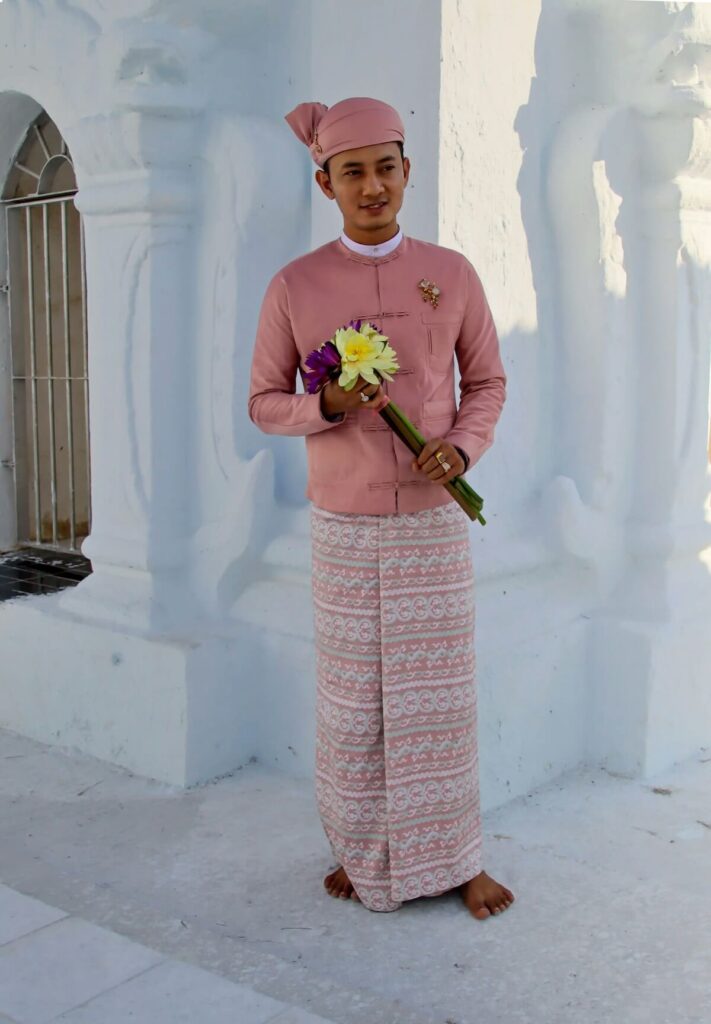
In many parts of the world, traditional dresses are reserved for weddings or holidays. But in Myanmar, the longyi is the undisputed king of daily wear. Myanmar is famous for this versatile garment, which comes in endless patterns, from simple stripes for work to intricate silk weaves for formal ceremonies.
This simple, cylindrical piece of cloth is worn by almost everyone—men tie it in a front knot (called a paso), while women fold it at the hip (known as a htamein). It’s remarkably practical for the tropical heat, allowing for a much-needed breeze while staying modest and respectful.
While it became the national standard during the British colonial era, the longyi remains a fierce point of pride today. You’ll see locals expertly re-tying their knots on street corners or even using the fabric as a makeshift bag or sunshade. It is, quite literally, the fabric that holds the country together.
9. Laphet thoke

While most of the world drinks tea, Myanmar is one of the few places where people actually eat it.
Laphet thoke is a savory, funky, and addictive salad made from fermented green tea leaves. Historically, this dish was served as a peace offering between warring kingdoms, symbolizing a shared bond over a meal. Today, it’s the ultimate snack, appetizer, and social glue, served at everything from casual family dinners to grand wedding ceremonies.
The magic of the salad is in the texture. The soft, tart tea leaves are mixed with a crunchy “fried bean” assortment, toasted sesame seeds, garlic, chili, and sliced tomatoes. It’s an explosion of flavors—salty, sour, bitter, and spicy all in one bite.
You’ll often see it served in a traditional laphet ohk, a beautiful lacquerware tray with separate compartments for each ingredient, allowing everyone to mix their own perfect mouthful.
10. Mohinga
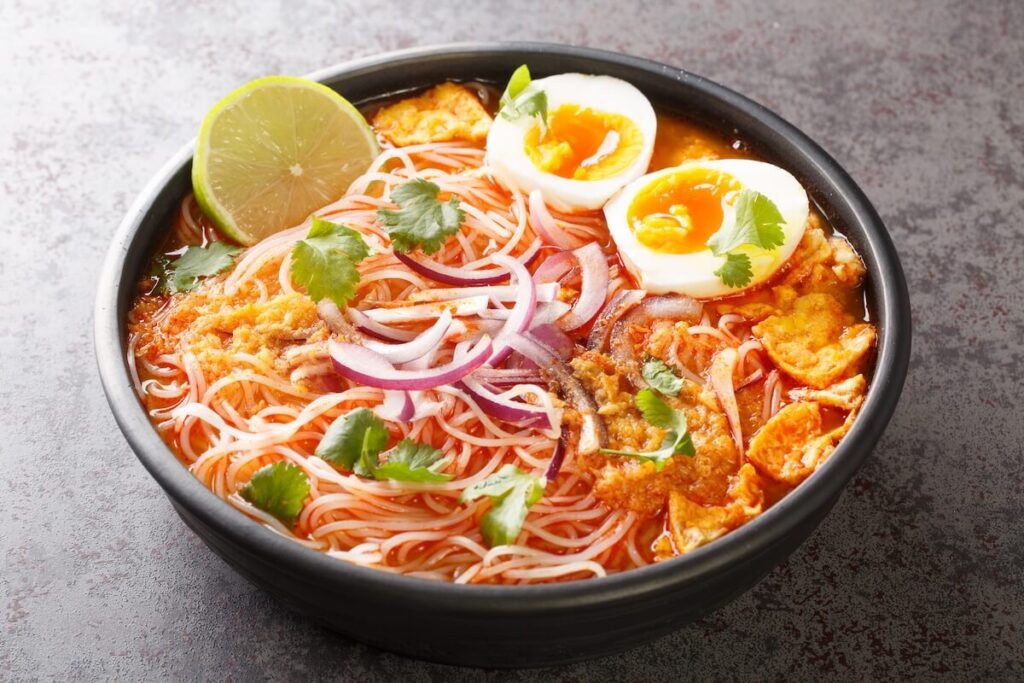
If Myanmar had a heartbeat, it would probably sound like the clinking of spoons against ceramic bowls at a roadside breakfast stall. That’s because Myanmar is known for mohinga, a hearty rice noodle and fish soup that serves as the ultimate national soul food.
Historically, mohinga was a humble dish sold by vendors on foot, but it has evolved into a beloved staple found everywhere from street corners to high-end hotels. The secret to a great bowl is the broth, thickened with toasted rice flour and infused with lemongrass, ginger, and banana stems. It’s typically topped with crispy fritters, a boiled egg, and a squeeze of lime to balance the savory fish base.
While it’s technically a breakfast dish, you’ll find locals slurping it down at all hours of the day.
11. Ethnic groups
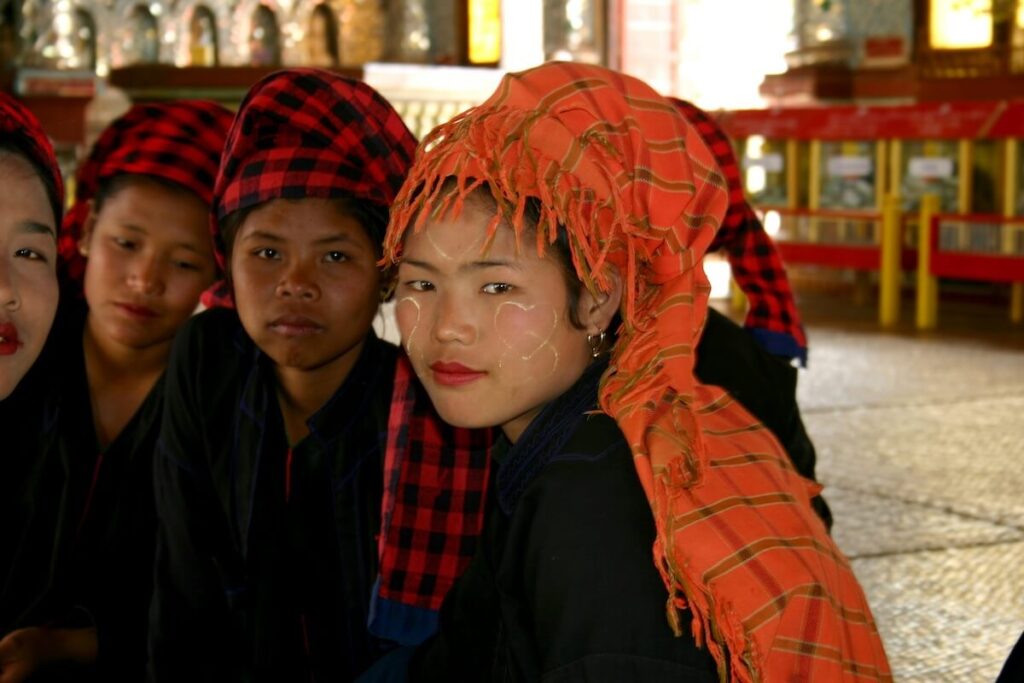
If you want to understand the true complexity of the country, you have to look at its people. Myanmar is famous for its incredible diversity, officially recognizing 135 distinct ethnic groups.
These ethnic groups are broadly categorized into eight “major national ethnic races”: the Bamar (who make up about 68% of the population), followed by the Shan, Kayin (Karen), Rakhine, Mon, Chin, Kachin, and Kayah.
This vibrant mosaic is the result of centuries of migration across the mountains from China, India, and Thailand. This diversity is the foundation of the country’s social fabric, but it’s also at the heart of its political struggles.
Each group brings its own unique language, dress, and traditions—like the intricate weaving of the Kayin or the famous festivals of the Shan. While the Bamar mostly inhabit the central plains, the minority groups traditionally call the rugged borderlands home. Exploring the country means encountering a hundred different ways of life, all coexisting within one border.
12. The Imperial System
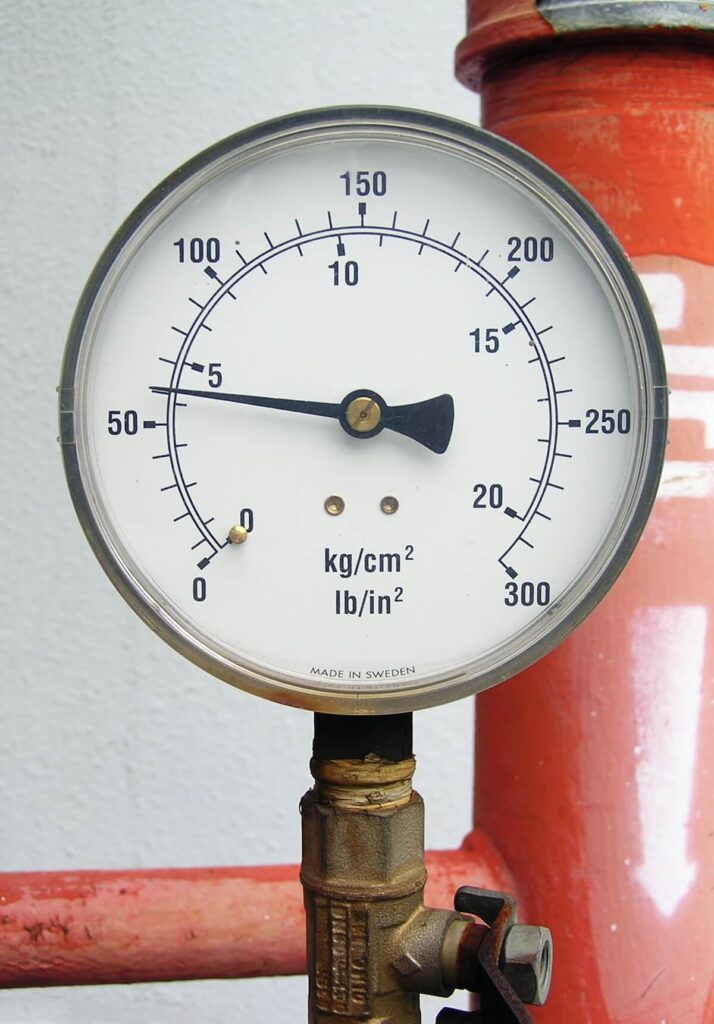
In a world ruled by meters and kilograms, Myanmar is a fascinating outlier. Along with the United States and Liberia, it is one of only three countries that haven’t fully adopted the metric system.
This quirk is a mix of colonial history and deep-rooted local tradition. While you might see kilometers on newer road signs, you’re just as likely to hear distances measured in miles or weight measured in the traditional “viss.”
One viss is roughly equivalent to 1.6 kilograms, and you’ll still see vendors at local markets using old-school balancing scales to weigh out produce. For travelers, this can lead to some head-scratching moments when checking fuel prices or buying gold. Still, it’s a logistical relic that adds to the country’s unique character.
13. The Burmese alphabet

At first glance, the Burmese script looks less like a writing system and more like a series of intricate, interlocking bubbles. This beautiful, circular alphabet is a major point of national pride and dates back nearly a thousand years.
Its unique shape isn’t just an aesthetic choice. Rather, it’s a brilliant bit of historical engineering. Back when monks and scholars wrote on fragile palm leaves, straight lines would have caused the leaves to split. By using curves, they could write freely without ruining their “paper.”
Consisting of 33 consonants and numerous vowel markers, the script is read from left to right, though the symbols can stack on top of or wrap around each other. While it can be intimidating for learners to master, you can’t deny that it’s a rhythmic, flowing system that can transform even a simple shop sign into a piece of art.
14. Chinlone

If you see a group of people standing in a circle, keeping a woven rattan ball in the air with gravity-defying kicks, you’ve found chinlone. This 1,500-year-old sport and traditional art form blends athleticism with dance.
What makes it even more unique is that there’s no opposing team and no winning or losing. The goal is simply to keep the ball off the ground using your feet, knees, and head in the most graceful way possible. It’s a mesmerizing sight to watch, often accompanied by live traditional music that speeds up as the players’ moves get more intense.
You’ll see it played everywhere, from dusty village corners to professional stages. Because it’s non-competitive, Chinlone is all about “flow” and mutual support among the players. It perfectly captures the Burmese spirit—focused, communal, and incredibly agile, all while wearing a traditional longyi tucked up between the legs.
15. The Kayan women

Myanmar is famous for the Kayan Lahwi people, often recognized by the striking brass coils worn by the women around their necks.
Contrary to the common “long-neck” nickname, the coils don’t actually stretch the neck; instead, the weight of the brass gradually pushes down the collarbone and rib cage, creating an elongated silhouette. This centuries-old tradition is a symbol of beauty and tribal identity, though today it’s a personal choice rather than a mandatory custom.
While these women have become a major draw for tourism, the practice is a subject of much debate regarding cultural preservation versus commercialization.
Many Kayan women now live in the Kayah State or around Inle Lake, where they demonstrate traditional weaving. When visiting, it’s best to engage with them as artisans and individuals rather than just photography subjects.
16. Largest country in mainland SE Asia

When people think of Southeast Asia, they often picture the sprawling islands of Indonesia or the popular beaches of Thailand, but in terms of sheer landmass on the continent, Myanmar is the heavyweight.
Covering over 676,000 square kilometers, it holds the title of the largest country in mainland Southeast Asia. Its vast geography is incredibly diverse, stretching from the snow-capped Himalayan foothills in the north all the way down to the tropical, white-sand Mergui Archipelago in the south.
This massive scale has historically made Myanmar a vital crossroads between the giants of India and China. And because it’s so large, the landscape changes dramatically as you move through it, shifting from dry, central plains to dense teak jungles and high plateaus.
For travelers, this means the country isn’t just a one-stop destination; its size allows for an incredible variety of climates and cultures that can make a single trip feel like you’ve visited three different nations.
17. The Golden Rock
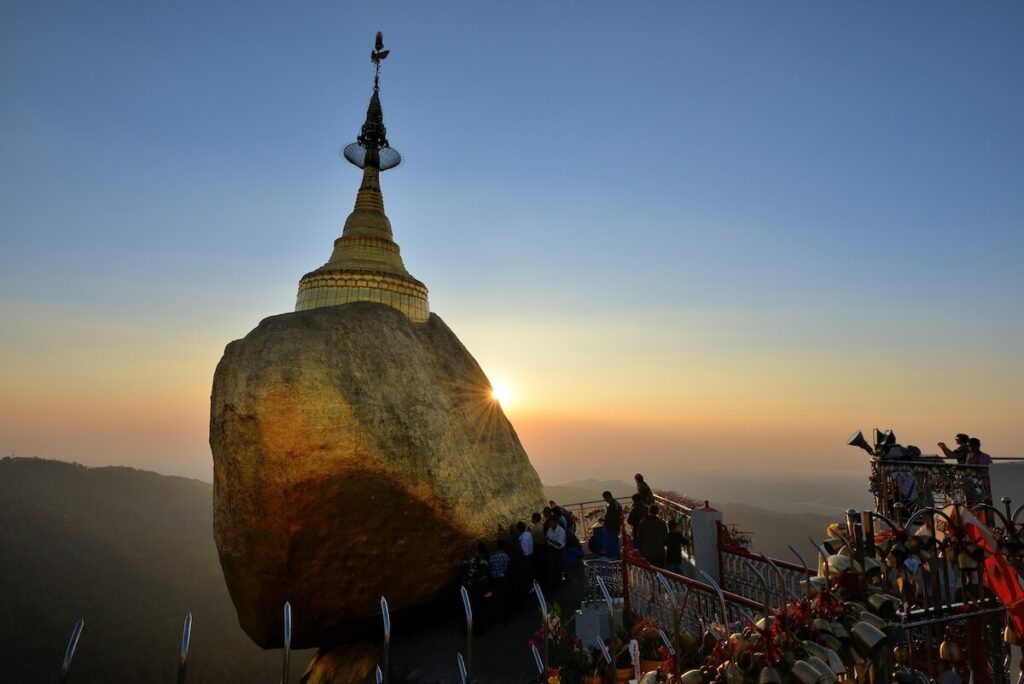
Perched precariously on the edge of a cliff in Mon State, the Golden Rock or Kyaiktiyo Pagoda is one of Myanmar’s most mind-bending sights. This massive granite boulder looks like it’s about to tumble into the abyss at any second, yet it has remained perfectly balanced for centuries.
According to local legend, the rock is held in place by a single, precisely placed strand of the Buddha’s hair. It’s the country’s third most important pilgrimage site, and the devotion here is palpable, with the air often thick with the scent of incense and the sound of rhythmic chanting.
The boulder is completely covered in layers of gold leaf applied by male devotees, giving it a brilliant, metallic glow that changes from pale yellow to deep orange as the sun sets.
Getting there is an adventure in itself, involving a wild, open-air truck ride up steep, winding mountain roads. The surrounding plaza offers a peaceful, electric atmosphere where everyone gathers to watch the “gravity-defying” miracle.
18. Driving on the right on right-hand drive
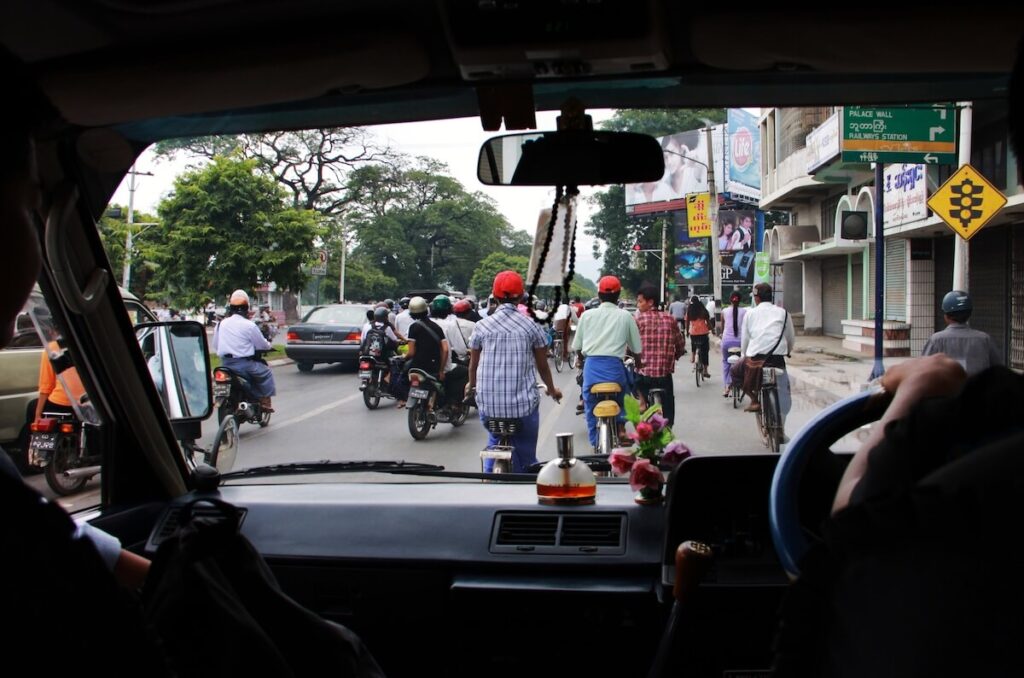
Of all the cultural quirks in Myanmar, the traffic system is perhaps the most disorienting for visitors.
While the country drives on the right side of the road, the vast majority of cars have the steering wheel on the right side as well. This creates a confusing “wrong-way” feeling where the driver sits toward the curb rather than the center line, making overtaking a two-person job involving a lot of leaning and teamwork from the passenger.
This bizarre setup happened overnight in 1970 when the dictator Ne Win abruptly ordered the country to switch from left-hand to right-hand traffic. Rumor has it he did this on the advice of an astrologer to “shift the country to the right” politically, though others say it was a move to distance Myanmar from its British colonial past.
Because most cars are still imported from Japan—where most cars are right-hand drive—the steering wheels stayed on the “wrong” side. It’s chaotic, but locals navigate with surprising ease.
19. “Kissing” sounds for service

If you’re sitting in a busy Yangon teahouse and hear two or three sharp, smacking “kiss” sounds, don’t be alarmed—nobody is blowing you a kiss.
In Myanmar, this “pucker” sound is the standard, perfectly polite way to get a waiter’s attention. While Westerners might find it a bit forward or even romantic at first, it’s actually the most efficient way to cut through the chatter of a crowded room without having to shout or wave.
This social quirk is deeply ingrained in daily life and is surprisingly practical. Most locals produce the sound by pursing their lips and making a short, staccato suction noise. It’s used everywhere from high-end restaurants to roadside beer stations.
If you’re a tourist, trying it out for the first time can feel a little silly, but the staff will appreciate the effort.
20. The “Death Railway”

Myanmar is known for its role in one of the most somber chapters of World War II: the construction of the Burma-Siam Railway.
Built by the Japanese Empire between 1942 and 1943, this 415-kilometer track was designed to move supplies from Thailand into Burma to support their push toward India. However, the human cost was staggering.
Over 60,000 Allied POWs and nearly 200,000 Asian laborers were forced to work in horrific conditions, leading to the deaths of more than 100,000 people from exhaustion, malnutrition, and disease.
Today, the northern terminus of the line sits in the town of Thanbyuzayat, where a war cemetery and a small museum serve as quiet memorials to those who suffered.
While the famous “Bridge on the River Kwai” is actually on the Thai side, the Burmese end of the tracks offers a raw, off-the-beaten-path look at the sheer scale of the project. It’s a powerful, reflective site that reminds visitors that Myanmar’s history isn’t just about ancient golden pagodas, but also about the heavy footprints left by global conflict.
Wrap up
From golden temples to the rhythmic “kissing” sounds of a teahouse, it’s clear that Myanmar is a country that refuses to be ordinary. Whether it’s the quiet pride of the longyi, the ancient artistry of chinlone, or the sheer geopolitical scale of being the largest nation in mainland Southeast Asia, Myanmar leaves a lasting impression on anyone who takes the time to look closer.
Ready to see the “Golden Land” for yourself? Start planning your trip today to experience this incredible diversity firsthand! Our list of travel deals and discounts might be helpful for finding the best bang for your buck.
And if you’re looking to extend your journey, don’t forget to check out the unique charms of Myanmar’s neighbors—Thailand, Vietnam, Malaysia, the Philippines, Indonesia, and Singapore—each offering its own unforgettable slice of Southeast Asia.