
A weekend in Salzburg is just enough to get a taste of the magic that permeates the city of Mozart and Baroque beauty.
As with any short trip though, it is always best to come well-prepared. That is where this handy 2-day itinerary comes in!
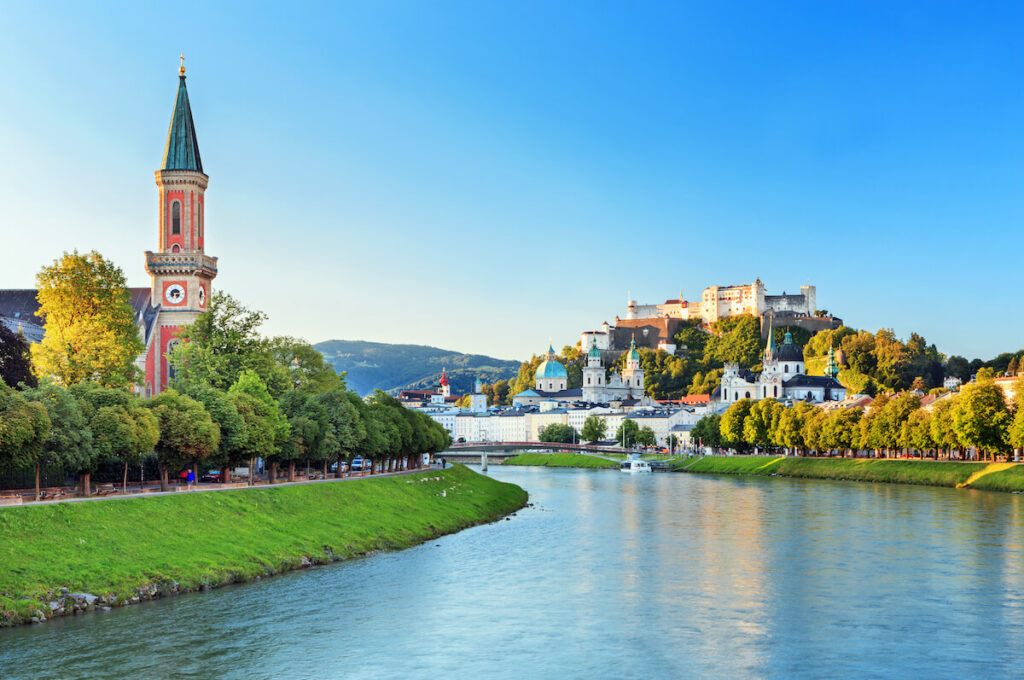
Loaded with exciting things to do and awesome places to see, it will arm you with all the knowledge you need to make your 48 hours in Salzburg as unforgettable as they deserve to be.
Table of Contents
Where to Stay

To be as close as you can be to all the major sights and wonders in Salzburg, I recommend Altstadt, the medieval Old Town.
Perfectly walkable and undeniably picturesque, this is the Salzburg you will recognize from the postcards. It also arguably wins out on sheer convenience as you won’t find more hotels per square mile in any other part of town.
Elisabeth Vorstadt represents a great alternative for those looking for more value and convenience.
Relatively close to both the Old Town and the Central Station but with a totally different vibe, Elisabeth Vorstadt is a mostly modernist proletarian neighborhood brimming with jazz music, unique accommodation, and a cosmopolitan flair.
How to Get Around
Salzburg is not as nearly as vast as the Austrian capital of Vienna or nearby metropolises in Germany and Switzerland, and its mostly pre-industrial layout makes it very easy to navigate on foot or by bike.
In fact, large parts of the city including almost all of the Old Town are car-free pedestrian zones year-round! Even by European standards, this makes Salzburg surprisingly easy to navigate without access to a vehicle.
However, this does not mean that the city doesn’t also benefit from a solid public transportation network.
Unlike its neighbors which mostly rely on trams and a metro system, Salzburg counts on its electric buses to ferry visitors from point A to point B.
While the following itinerary was written chiefly with walking in mind since this is how I saw most of Salzburg myself, you are free to zip around town by bus if prefer the extra convenience this gives you.
Day 1
Morning: Getting to Know Altstadt
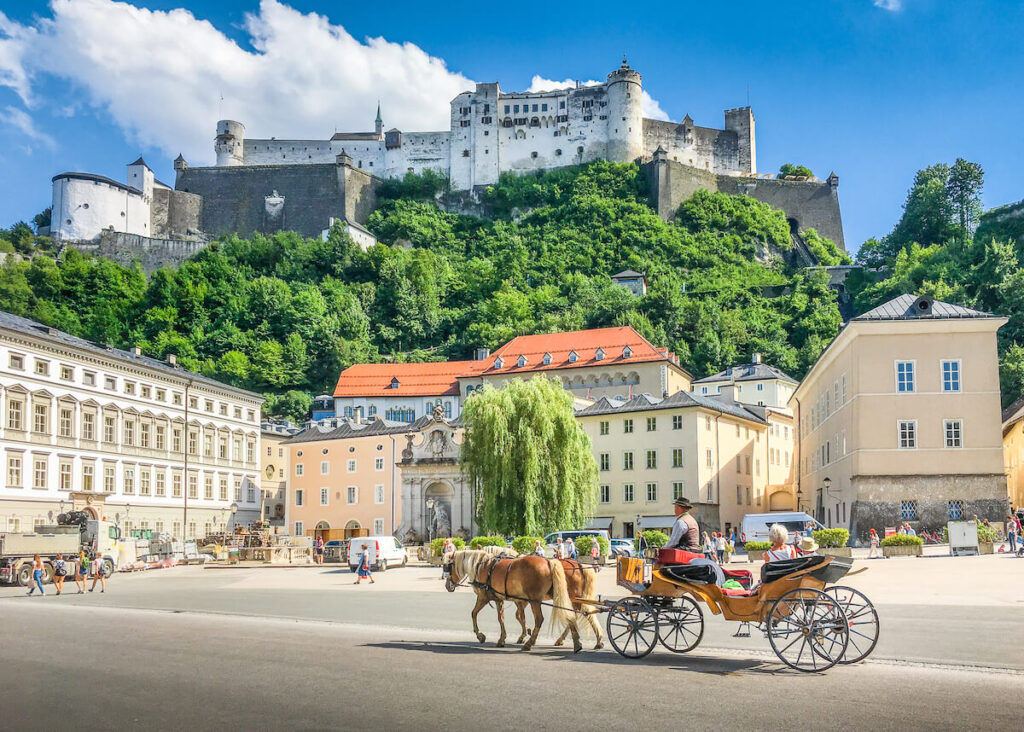
Start off your first day in Salzburg exactly the way you imagined: by exploring the dense, cobblestone-lined alleyways of the Old Town.
Head in the direction of Mozartplatz — yes, that Mozart, and there’s a statue of him in the middle of the square just to confirm.
While this Platz served as the most significant public square even before Mozart’s birth, it is since its official name change that it has really blossomed and thrived.
This should be easy to tell on your morning stroll: stunning architecture ranging from 19th-century neoclassicism all the way to early, French-style baroque surrounds you from every direction.
Feel free to marvel at the remains of the old city walls, which span the entire circumference of the square. You will also be able to easily spot numerous sights, including the former residence of Mozart’s wife, Constanze Mozart-Nissen.
On top of that, the whole square is littered with eateries and little markets, and boutiques galore.
I suggest heading to the Café Glockenspiel, one of the city’s oldest establishments that serve typical Austrian delicacies with a decidedly traditional ambiance.
From there, it’s only a short skip over to the Residenzplatz, home to the former seat of the archbishops that used to rule over Salzburg.

You can still view their beautifully-preserved palace here, known as the Alte Residenz (Old Residence). While not occupied by any royalty any longer, the building is still open to the public, housing an art gallery and a museum chronicling the rise and fall of the monarchy there.
On the opposite end of that square, there is a Neue Residenz (New Residence) to match, which was constructed a few centuries later.
Just like its sibling, it now serves as a museum, called the Salzburg Museum, which houses a large collection chronicling the artistic and cultural history of the city.
There are hardly any better ways to really get to know Salzburg in such a short amount of time – and it doesn’t hurt that walking through the ornamental halls of the New Residence is quite a sight by itself!
Note that the large public square that both of the Residences share is often used for public performances and events.
For instance, if you’re traveling to Salzburg during wintertime, I highly recommend checking out the Christmas Market.
Nearly the entire Old Town will be dressed up in colors and lights, but the Residenzplatz in particular will be the stage for plenty of festivities that are a joy to behold in person.
If it’s your first time in town, though, the large crowds and the sheer number of Christmas Market festivities can get quite overwhelming, so consider if a guided tour might be worth it.
Afternoon: Treading in Mozart’s Footsteps
You can’t take Mozart out of Salzburg in much of the same way as you can’t take Salzburg out of Mozart. The composer’s life, love, and work all revolved around the city, and the local authorities have really done a lot to put that on proper display.
You have already seen the large Mozart monument and the former residence of his wife, but there is much more to explore elsewhere in Salzburg’s Old Town.
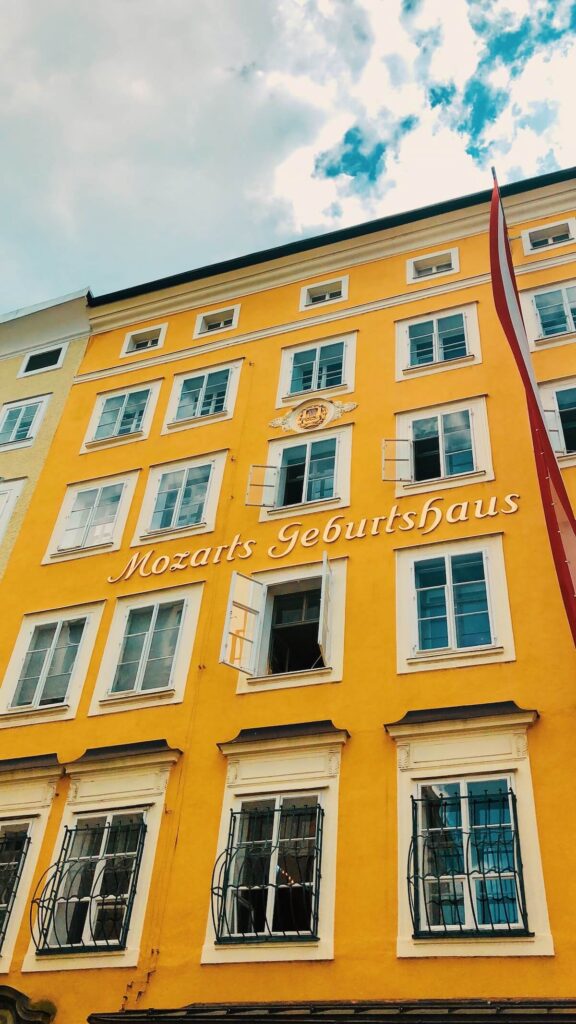
Head down Getreidegasse, where building number nine should be the object of your attention. Likely, there will be a sizeable crowd gathering outside anyway, so it is not a difficult place to spot.
This, dear traveler, is Mozart’s birthplace and longtime residence, now refashioned as a time capsule-style museum chronicling his life and work.
It’s a visit I highly recommend to anyone visiting Salzburg as it not only gives you incredible insight into Mozart’s life but also helps to give a rough idea of what it was like to live in Salzburg during the Classical period.
Feel free to explore the rest of Getreidegasse afterward – despite looking like a narrow alleyway at first glance, it hides a ton of little secrets.
Take a good look at those metal signs, emblems, and insignias hanging from the facades. Most of these are ancient guild signs that still guide you to some of the historical businesses operating here. Little family-run convenience stores, bakeries, cafés, restaurants, the list goes on!
What’s more, if you keep your eyes peeled for little gaps in between those signs, you might uncover hidden passageways leading off into beautiful gardens, small parks, or historic courtyards.
So, as tight and compact as the Old Town of Salzburg might seem, it has a lot in store for those who know where to look!
When you’re done sniffing around the nooks and crannies of Getreidegasse, head on due north, hopping across the river to arrive at Schloss Mirabell.

Yes, another pristinely preserved castle in Salzburg, and not the last one you’re going to see during these 48 hours, either!
The Mirabell is special. Its lush, meticulously trimmed gardens invite visitors to explore and relax and are gorgeous to visit at any time of day.
The inside of the palace is just as stunning as the greenery outside. There’s the awe-inspiring Marble Hall, which is nowadays commonly rented out for weddings.
The Hall also leads us to another connection between Salzburg and Mozart: this is the place where both the composer himself as well as his father held some of their first public performances.
The rest of Schloss Mirabell, with all its baroque pomp and glamour, is equally stunning and deserves a proper tour – thankfully, it’s open to the public year-round, all week, and admission is free!
Another top spot to visit in Salzburg is the Salzburg Cathedral. A pristine example of Italian Baroque, thousands visit every day to marvel at the stuccos and frescoes inside as well as the beautiful ornamentation all over the facade.
This Salzburg jewel, too, has a connection to the life of Mozart (seeing a pattern yet?). The Cathedral is where the composer-to-be was baptized, and in fact, the original baptismal font used then still stands within the church today!
Evening: Salzburg from Above
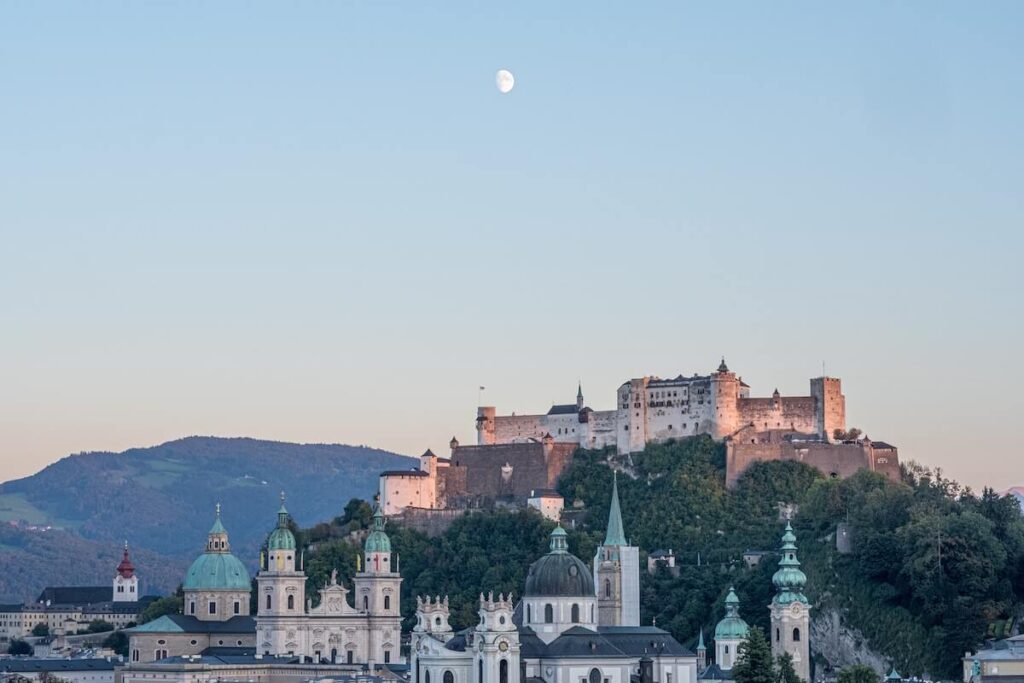
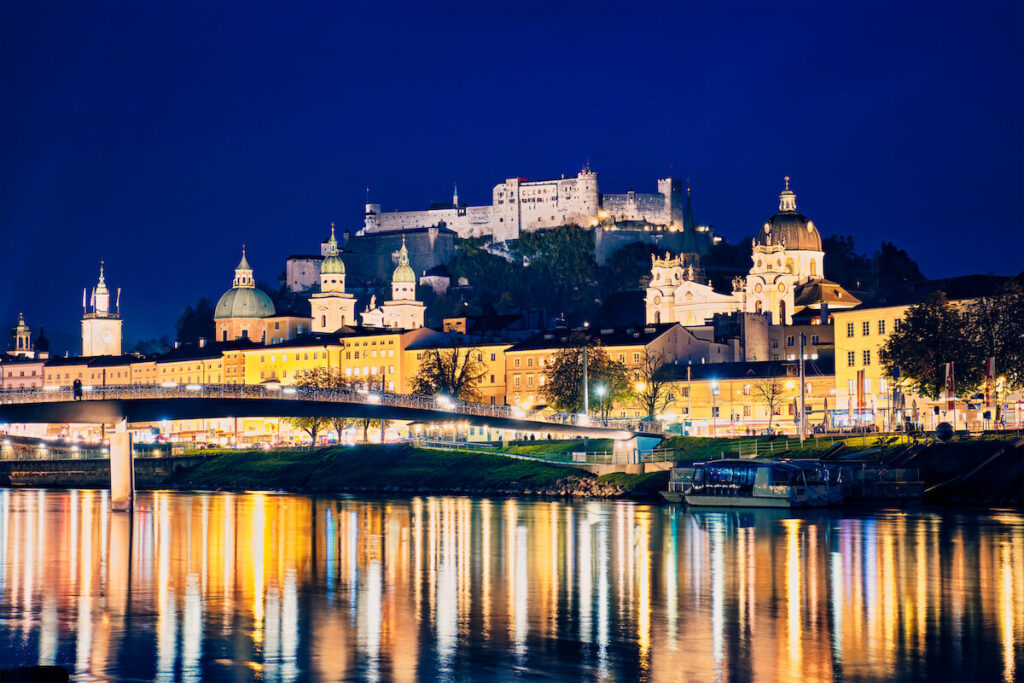
One of the first things to catch your eye in Salzburg was probably on the horizon — that medieval castle looming over the city from a hilltop in the distance.
You might be surprised to hear that you can actually visit that castle, and it doesn’t require any harsh hiking or climbing whatsoever!
The Festung Hohensalzburg, literally “Fortress Salzburg Heights”, is easy to reach nowadays thanks to a funicular called the Festungsbahn, which can take you all the way up from Bierjodlgasse (yup, that’s “Beer Yodeling Alley”).
Alternatively, if you can spare the time and fancy a long walk instead, there is a whole castle trail laid out from the Old Town to the summit of the hill!
At the top, you will not only get to explore most of the stunning 11th-century architecture, beautifully preserved as everything else in Salzburg, but you’ll also get a terrific view of the whole city that’s perfect for postcard-ready snapshots!
The fortress is not just preserved in its original entirety, but also includes various expansions that were added over the centuries. This makes it one of the largest medieval structures still standing in Europe.
Among other sights, it also contains the so-called Golden Hall, where – guess who – Amadeus Mozart used to perform. The concert hall is still used today for this purpose, with performances of Mozart’s compositions remaining the main draw.
Finish off your evening with dinner at Die Weisse, a world-class restaurant and brewery. If you have even the slightest taste for fine craft beer, this place deserves a visit.
Make sure to call ahead of time though to make sure they’re free over the weekend – those days can get very full in Austria, and reservations are welcomed.
Day 2
Morning: Exploring Salzburg’s Winter Wonderland

After grabbing some hearty breakfast in the Old Town – at the Tomaselli for instance, which is reputed to be Salzburg’s oldest café still standing – head out to Eisriesenwelt, one of the most surprising sights in Salzburg that no visitor should miss.
What lies here just outside the city limits, hidden underground, is the world’s largest ice cave, ready for you to explore. Yes, you read that right. The world’s largest ice cave is in Salzburg, Austria.
Make sure to book tickets ahead of time and arrive early; that way, you can really explore all that Eisriesenwelt has to offer.
Opting for a guided tour can only enhance the experience further while taking transport from and to the caves out of the equation.
Afternoon: More Royal Delights
When you’re back from your excursion to the icy caves of Salzburg, indulge in a gentler kind of trip by the riverbank.
This is your chance to see some of the more peripheral neighborhoods outside of the Old Town. My recommendation for this itinerary is to start with Elisabeth Vorstadt and work your way down south from there, following the river.
I’d suggest renting a bike for this part of the trip to make the experience more enjoyable and to save some time, though you could certainly make it on foot too if you prefer.
From jazz bars to boating tours, this side of Salzburg is littered with opportunities for weekend leisurely fun. You can also stop for lunch or supper at The Glass Garden, a riverside restaurant of Michelin-star quality just across the water from Neustadt.
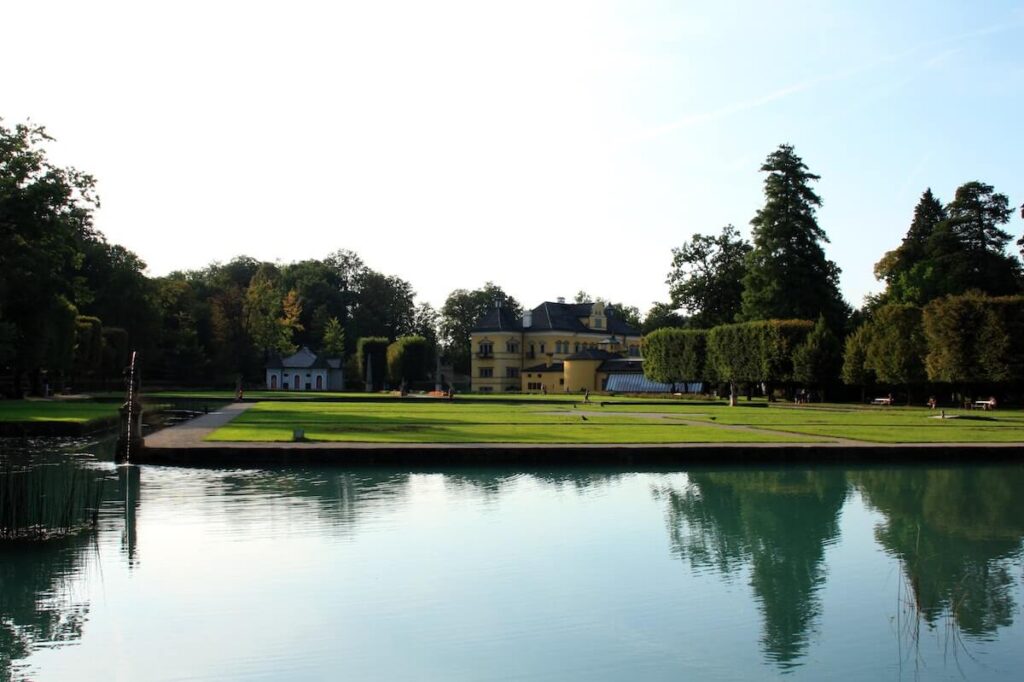
If you have the energy for another ride to the outskirts after your meal, continue southbound along the river’s left bank; you will soon see Hellbrunn Palace in the distance.
This chateau-style palace is not like the other examples of pristinely preserved architecture in and around Salzburg. For starters, you have truly gigantic gardens to explore, spanning over 145 acres!
But unlike the greenery surrounding Schloss Mirabell, these do not stop at pretty flowers and neatly-trimmed hedges.
All throughout the gardens, there are hidden works of marble, wood, and stone, and many of them are loaded with jeux d’eau – trick fountains that spray water at unsuspecting visitors if they take a wrong step or sit down on one of those invitingly-crafted benches or stools.
This was the 17th-century Baroque architect’s idea of slapstick humor, and judging by the popularity of Hellbrunn Palace, it still holds up today.
Because of the sheer size of the palace, you could easily find a day’s worth of activities here to enjoy. From an ancient stone theater that’s still used for performances today to underground grottos begging to be explored, Hellbrunn is an amazing excursion that’ll amaze and delight, for sure.
Avid cinephiles will also recognize the site of the Palace as one of the key filming locations for The Sound of Music!
Fans of the movie and the real-life history behind it actually organize treasure hunt-style city tours where the goal is to discover all of the locations in and around Salzburg used for filming (I’ll give you a hint: it’s a lot more than you might think).
Evening: Love, Goodbyes, and Riverside Walks
I don’t know about you, but for me, few places are more intensely romantic than Salzburg around sunset. Give the city a proper sendoff for the weekend by visiting some of its most love-tinged sights.
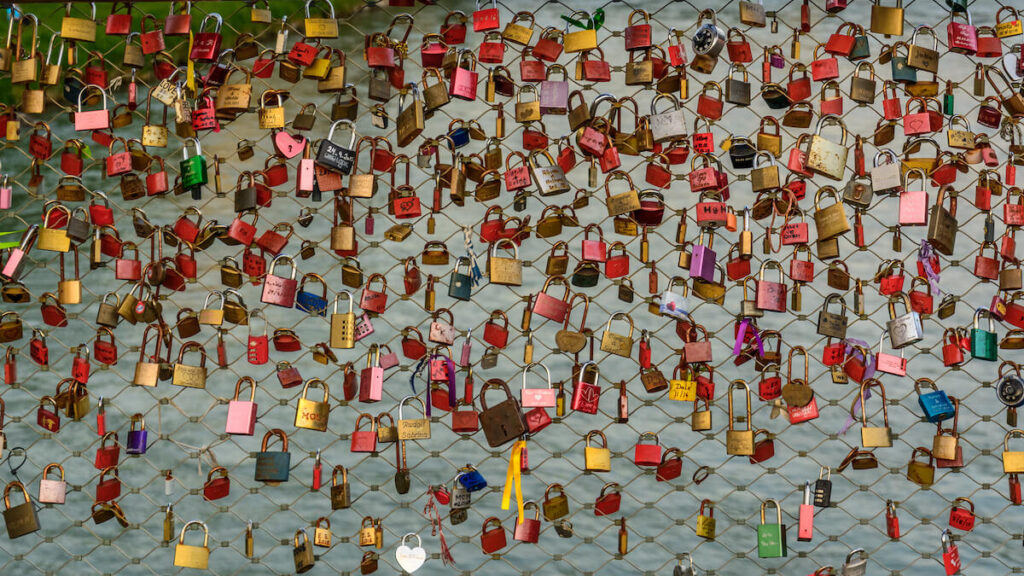
I recommend the Love Locks Bridge, for starters. Some might view it as sentimental to the point of kitsch, but I can’t help but smile at the sight of those hundreds and hundreds of little locks chained to metal, each representing a couple that once was, many of which might still be.
From here, you also get excellent shots of the amber sun looming over the water.
Right by the river, you’ll also find the Volksgarten, the city’s largest park and public green area. In the summer, plenty of outdoor activities and events are hosted here, such as free movie screenings, public courts for volleyball, soccer, and other sports, as well as communal running and cycling paths.
In the winter, most of that makes way for sports like figure skating instead.
For your final stop in Salzburg, I recommend an unconventional take: a visit to St. Peter’s Cemetery. Yes, it’s a graveyard, but I challenge anyone who has seen it in person to claim it isn’t one of the world’s most beautiful.
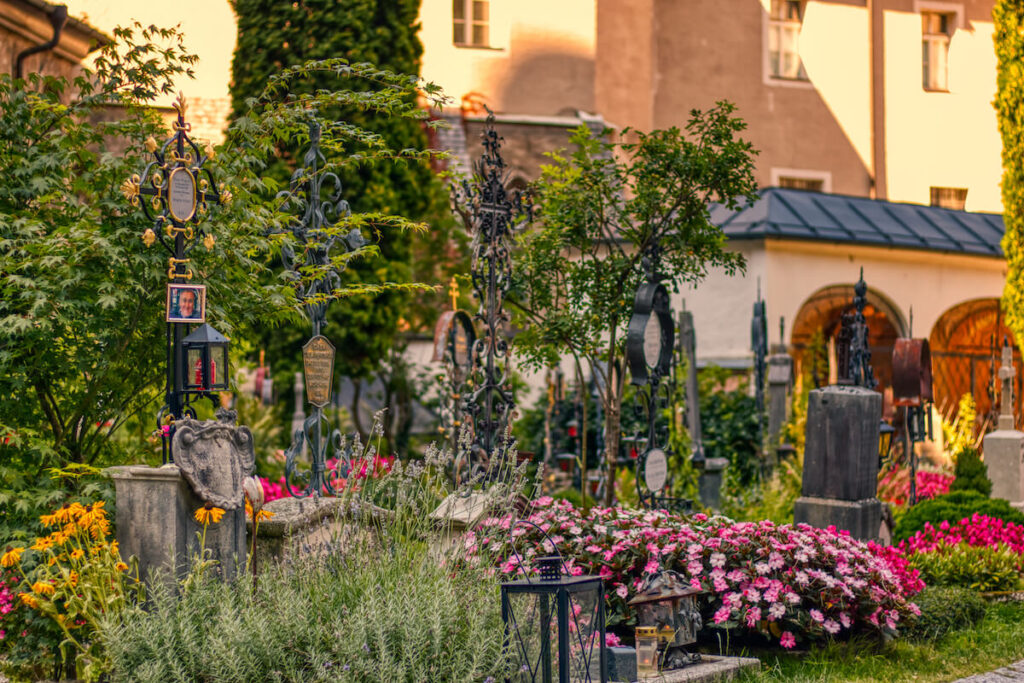
Whether you enjoy the bittersweet melancholy of cemeteries in general or not, St. Peter’s will definitely make an impression on you.
The tombs, and the catacombs spanning most of the area that you can access, date back to at least the 12th century, making them some of the oldest in this part of Europe.
It’s a different experience than the lavish mausoleums, artful monuments, and gravestones of, say, Paris’ Père Lachaise.
Here, the ambiance is a lot more somber and understated, and if you enter the chapels adjacent to the outdoor site, you will be able to view some ancient altars and other artifacts left behind and forgotten by time. Among them, if you look hard enough, you can spot the grave of Mozart’s sister, Marianne.
That is the last connection between Mozart and Salzburg for this weekend, I promise – and the most emotional, no less.
You can reach the cemetery by heading in the direction of the Festungsbahn – in fact, the location is right at the foot of the mount that the Festung Hohensalzburg sits on.
Inside one of the two chapels, you will also find arguably the best way to say goodbye to the city and all of its colorful history.
The name of the place is the Stiftskulinarium, and if that Germano-Latin doesn’t tell you much, how about “the oldest restaurant in the world?”
Well, to be fair, that title is still being disputed (it would be stranger if it wasn’t), but we do know that the Stiftskulinarium at St. Peter’s has been operating since at least the 8th century CE.
That it is still serving Michelin-starred dinners to its guests today should tell you at least a bit about what you should expect.
For me, it combines everything memorable about Salzburg: the tradition, the history, the passionate affection for the past, and of course, the love of good food.
So enjoy your meal, lean back, and think about everything you have seen and done during these past 48 hours.
Don’t forget to be up early the next morning for your flight or train back home!
See you back in Salzburg soon!