
Given that Greece is a country with a very long history and is famous for a variety of things, it is natural it would be talked about a lot.
But this doesn’t mean that everything you hear about it is true. In fact, it is about time that a lot of circulating stereotypes about Greece and its people are debunked.

Let’s dive right into this!
Table of Contents
Stereotypes about Greece
1. Greece is always hot and sunny

One of the biggest misconceptions about Greece is that it’s all hot weather and endless sunshine. Many people assume the weather never changes in Greece and that you can just go and enjoy its many beaches at any time of the year.
Well, let me tell you: nothing could be further from the truth. Not only does Greece have proper seasons, but its winters are as cold as its summers are hot. If you don’t pack a warm coat for your winter trip to Greece, you will bitterly regret it.
2. Whitewashed houses are the norm in Greece

A common Greece stereotype is that it’s all whitewashed houses with blue doors and windows under thick veils of pink bougainvilleas. The popularity of Cycladic imagery is largely responsible for this perception.
Even though Greeks would love nothing more than to live in these gorgeous houses on idyllic narrow cobblestone streets, the majority of them don’t.
The whitewashed houses that likely come to mind when you think of Greece are typical of the Cyclades islands, like Santorini, in the Aegean. The rest of the country, however, is dominated by blocks of flats and houses that look nothing like that.
3. The only destinations worth visiting in Greece are its islands

Greece has over 200 inhabited islands, so it’s easy to see how one might get the impression that’s all there is to the country.
While the islands are undeniably great, the truth is some of the best tourist destinations in the country are actually its mountains on the mainland.
From Zagorohoria in the Pindus mountains to Pelion’s countless villages, Greece has a lot more diversity than it’s given credit for. It even boasts some great ski centers in places like Kalavryta and Metsovo. Mind-blowing, right?
Stereotypes about Greek people
4. They are loud

This is perhaps one of the most common stereotypes about Greeks and it is one they share with Italians, Spaniards, and other Mediterranean people. Visitors to the country are often puzzled by Greek people’s volume. Why are they shouting? Are they fighting? Do they all have hearing problems?
The truth is there is nothing to worry about. That’s just how we speak here. But Greeks don’t typically self-identify as “loud”, simply because that’s the volume they are used to.
A possible explanation is that this stems from the fact they have to speak up to get heard in big families.
5. They are lazy

Throughout Europe, there is a prevailing stereotype that Greeks are lazy.
Indeed, Greece is not a country known for its efficiency. Greece’s public transport is not punctual, its bureaucracy is a nightmare, there are a lot of strikes and people love a good siesta. From all this, it is easy to conclude that the Greeks must be lazy.
But a simple look at statistics is enough to disprove this stereotype. According to the Organisation for Economic Co-operation and Development, Greeks work the longest hours in Europe, making them some of the most hard-working people on the continent!
6. They are hairy

Many people think Greeks are very hairy. The stereotype is that they all have big, unruly hair: on their head, arms, chests, legs, eyebrows, you name it.
A long time ago, this may have well been true. According to science, hair is an evolutionary advantage that helps to protect oneself from intense sunshine, which Greece is known for.
However, in my personal experience, this is a misconception. As a teenager, I vividly remember comparing my dark leg hair to that of my fair Polish friend as an experiment. The amount of hair was the same. The difference was that hers was so light it almost looked transparent!
7. They all smoke

Even though not all Greek people smoke, this stereotype is, unfortunately, rooted in reality. Greece has the highest proportion of smokers in the EU.
An indoor smoking ban was imposed in the country in 2009, but it wasn’t particularly effective in its infancy. Fearing they would lose a large percentage of their clientele, many establishments would, for a long time, try to find loopholes in the smoking law.
In recent years, however, the advent of vapes and e-cigarettes has brought about a change in people’s habits, making smoking less tolerated.
8. They are very superstitious
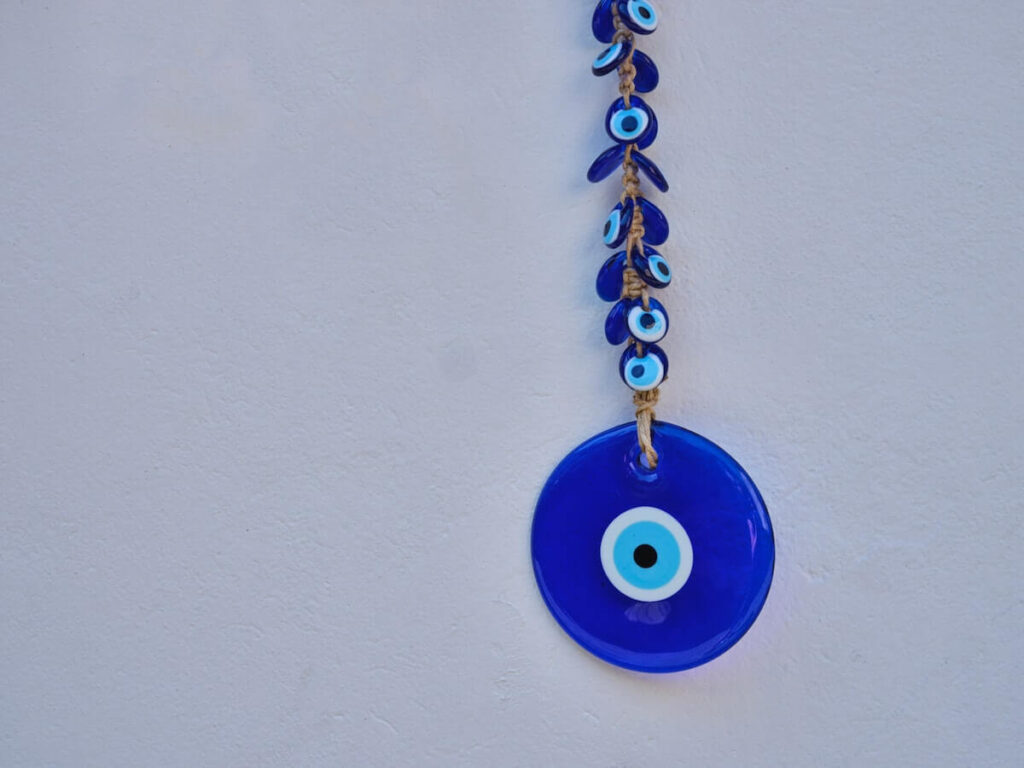
If you have ever witnessed a Greek spit on someone to protect them from the evil eye, it will be hard to convince you that Greeks are not superstitious. I can’t deny that this happens, probably more than it should. But if it’s any excuse, it’s older generations of Greeks that do things like this.
Traditions such as reading one’s fortune from the patterns of leftover Greek coffee in a cup to superstitions like avoiding black cats and touching wood are mostly a thing of the past.
You’ll be hard-pressed to find a young Greek person that wears an evil eye charm as anything more than a fashion statement.
9. They have really big families

Movies like “My Big Fat Greek Wedding” have helped perpetuate the idea that Greeks have very large families.
But, in reality, Greece has one of the lowest birth rates in Europe, making it one of the fastest-aging countries in the world. This disproves the stereotype that Greeks have big families. If anything, younger generations of Greeks are crippled by financial security and, so, choosing not to have children.
What is true, however, is that Greeks value the concept of family. Even if a Greek family is not big, it’s typically close-knit. It’s not uncommon to know and be close with one’s cousins (first, second, and even further removed!), aunts and uncles, godparents, and other family members.
10. They are super proud

Greeks are quite proud, that much is true. Even if their levels of pride do not match Gus Portokalos’ (the father of the bride from “My Big Fat Greek Wedding” who maintained that the root of every word is Greek), it is safe to say most Greeks are proud of their country.
This does not mean they live in denial though. Greeks will be the first to admit their country has serious sociopolitical and economic problems.
But it also has delicious food, incredible weather, and some of the most beautiful locations in the world. And who wouldn’t be proud of that?
11. They are good-looking

Adonis, Aphrodite, Greek kouros, and kore statues… Do you see where I’m going with this? It is easy to see how the stereotype of Greeks being good-looking came about.
If typical Mediterranean features, like brown eyes and hair, are your thing, you will probably agree.
But since beauty is in the eye of the beholder, it’s hard to say if this stereotype is true or not. I’ll leave it up to you to decide. Personally, I think there are good-looking people everywhere, including in Greece!
12. They are hospitable

Greece is famous for the hospitality of its people. And if you’ve ever visited Greece, chances are you will agree.
Whether it’s a drink of raki or a sweet homemade spoon to welcome you to somebody’s home, Greek people take pride in pampering guests, especially foreigners. They put a lot of effort into making them feel right at home.
If you meet somebody who doesn’t or acts apathetic towards foreigners, they are in the minority. This is one stereotype about Greeks that is 100% true.
13. They love to smash plates

If I had a penny for every time a friend from abroad asked me if I would be smashing plates to celebrate my birthday or a special occasion, I’d be a very rich lady.
Much to their disappointment, I always have to explain this is not really a thing in Greece. Not anymore, anyway.
Plate smashing was a popular practice at Greek live music venues called ‘bouzoukia’ between the ‘60s and ‘90s. Patrons would drink, dance, and smash plates to show they were having a good time. Obviously, the practice wasn’t exactly safe and, over the years, common sense prevailed.
These days at the bouzoukia you can buy flowers to throw at the singers as a sign of appreciation. Much gentler!
14. They don’t flee the nest until their 30s

They say Greek people live at home until well into their adulthood. And it’s true. A large percentage of Greeks don’t move out of their homes until they have a good reason to.
But, unlike what you might think, this isn’t because they are waiting for marriage. That’s an outdated concept. The reasons are, unfortunately, even bleaker than that.
Salaries in Greece are very low compared to the rest of Europe and most young people cannot afford to live on their own. Living with their parents allows people to study and work while saving money for the future.
15. Greek men are mommy’s boys

Greek men have a reputation for being mommy’s boys. There is certainly some truth to that, but, like a lot of things on this list, this is something that is changing with younger generations.
In Greek men’s defense, older Greek mothers offer a smothering type of love that’s hard to say no to. They spoil their boys, cooking for them constantly and doing their laundry. They don’t want them to lift a finger because that’s a woman’s job.
Thankfully, younger mothers have been rejecting this mentality, focusing on raising independent children, whether these are men or women.
16. They speak ancient Greek

Classics are a popular subject in many schools and universities around the world. Oftentimes, people who have been studying it will come to Greece and use ancient Greek phrases they have learned in class, assuming everybody speaks them.
Unless you want to be met with blank stares, don’t do that, because this is 100% a misconception.
Even though the alphabet is the same and they share some common vocabulary, modern and ancient Greek have very little in common. Ancient Greek is taught at Greek schools for a short amount of time and it’s safe to say that most people forget it as soon as they graduate, since it doesn’t have any real-life applications.
17. They hate authority

If you mention you’re going to Athens, you’re sometimes met with “But isn’t that unsafe?” The city has a reputation for being a central protest hub and Greeks are stereotyped as being very anti-authority.
It’s not hard to see how someone might arrive at that conclusion. Images of hooded youths throwing Molotov cocktails at armed police in front of the parliament always make the news rounds and get people talking.
These images perpetuate the stereotype of Greeks as being against their government, police, rules, and, really, any type of authority. But it would be wrong to think of Greek people as rebels without a cause, protesting for the fun of it.
Over the last two decades, Greece has experienced a great amount of financial and sociopolitical turmoil. The country has been facing serious problems with issues like corruption, inequality, unemployment, and immigration… and that’s just the beginning of it.
Greek people tend to speak up for themselves and, sometimes, the only way to get heard is to protest.
Conclusion

Stereotypes are overgeneralized beliefs that come to be as a result of an attempt to understand something that is foreign to us. While they don’t necessarily always come from a malicious place, it is important to stop and think critically before perpetuating a stereotype.
Hopefully, in this article, we have helped to set the record straight on some common beliefs about Greeks and their culture!
Are there any stereotypes about Greek people that you have found to be true or untrue during your travels?
Stereotypes about Greece and Greeks – Pin it!



in my view greece is a bit crap thats all