
Found a unique rock on your travels, perhaps a smooth river stone from a scenic hike or a sparkling crystal from a local shop, and now you’re wondering, “Can you bring rocks on a plane?”
Believe it or not, it’s a common question, and navigating airport security with seemingly innocuous items can often lead to confusion and unnecessary stress.

This article aims to clear up that uncertainty by providing comprehensive information on the TSA rules for carrying rocks in both your carry-on and checked luggage, along with practical tips. Understanding these guidelines is crucial to ensure a smooth journey, helping you avoid unexpected delays, potential confiscation, and the frustration of leaving your cherished find behind.
Please note: The following has been written using the FAA and TSA guidelines for flights in the U.S. If you are traveling from or in another country, please ensure you check their guidelines for safe flight and permitted substances before check-in.
Table of Contents
Can you bring rocks on a plane?
The good news is that, for the most part, yes, you can bring rocks on a plane. The Transportation Security Administration (TSA) generally permits inert, non-hazardous items in both carry-on and checked luggage. This means your geological finds, from polished stones to raw mineral samples, are typically allowed.
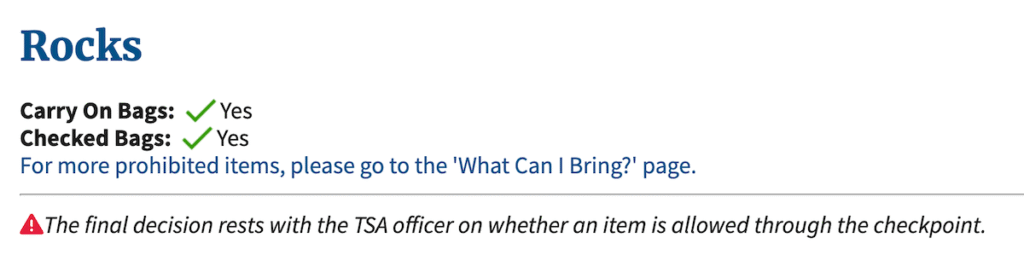
However, as the TSA’s website states, it’s crucial to remember that the final decision always rests with the individual TSA officer at the security checkpoint, who has the authority to prohibit any item they deem a security risk.
While rocks are generally permitted, they might still draw extra attention during security screening. This is often due to their density, which can make them appear as an unidentifiable mass on X-ray machines, potentially obscuring other items.
Rocks with sharp edges or points could also be questioned if they are perceived as a potential weapon. So, to avoid any issues, it’s always best to be transparent; never attempt to conceal rocks or any other items, as this can lead to delays and further inspection.
What about sand, you ask? Bringing sand, which falls under “powder-like substances,” is generally allowed, with a few caveats.
Sea glass, another kind of treasure you’d likely find on beaches along with rocks and sand, is also allowed on planes.
Thanks for asking! Seaglass and small rocks are good to go in carry-on bags.
— AskTSA (@AskTSA) June 29, 2019
Also read: Can You Bring Plants on a Plane? Here’s the Answer
Can you bring rocks in your carry-on luggage?
Yes, carrying rocks in your hand luggage is generally allowed. However, there are a few important considerations, primarily revolving around weight and size.
Each airline has its own specific weight limits and restrictions for carry-on bags, and a heavy rock can quickly push you over that threshold. So, before you pack, it’s a good idea to check your airline’s policy to avoid any last-minute surprises or extra fees.
2: Each airline has different weight and size requirements for carry-on bags. Please visit your airlines website so you won't have any surprises when you get to the airport.
— AskTSA (@AskTSA) June 3, 2023
Plus, the physical size of your rock matters; it needs to comfortably fit within the dimensions allowed for overhead bins or under the seat in front of you.
Also, note that rocks, being dense objects, can sometimes cause issues at the X-ray machine during security screening. Their solid mass can make it difficult for screeners to see through your bag, potentially obscuring other items.
Because of this, you should be prepared for the possibility of a bag check. To help expedite the process, it’s best to take your rock out of your bag and place it in a separate bin for screening, similar to how you would with electronics. This can give the TSA officers a clearer view and potentially prevent a manual inspection of your luggage.
One final point to keep in mind is the rock’s shape. While most rocks are fine, any rock with very sharp edges, pointed ends, or that could reasonably be perceived as a weapon might be prohibited by TSA. This is consistent with their rules on other sharp objects.
So, while these sandstones and agates are okay…
@AskTSA Can these rocks go in a carry on bag? Thanks! pic.twitter.com/GwFrQjQoAE
— Leslie (@Lap918) June 30, 2022
…if you have a particularly jagged or weapon-like rock, it’s almost always safer to pack it in your checked luggage to avoid any issues at the security checkpoint.
Can you bring rocks on a plane via checked luggage?
If you’re looking to transport your geological finds, checked luggage is actually more straightforward and preferable, especially for heavier, larger, or even jagged rocks.
The good news is that the TSA is quite accommodating of rocks in checked bags. This option provides more flexibility in terms of size and weight compared to carry-on restrictions, and it also eliminates the concern about sharp edges that might raise flags at the security checkpoint for hand luggage.
For example, the TSA recommends packing this Paleolithic hand axe, which has sharpened edges, in a checked bag.
Thanks for the photo! We recommend packing your Paleolithic hand tool in checked bags.
— AskTSA (@AskTSA) February 20, 2022
While checked bags offer more leeway, it’s important to remember that airline-specific weight and dimension restrictions still apply. These limits are typically more generous than those for carry-on bags, but exceeding them can still result in overweight baggage fees or the need to repack.
Always check your airline’s specific policies regarding checked baggage allowances before your flight to ensure a smooth check-in process and avoid any unexpected costs. If the rock is too large or too heavy, consider shipping as an alternative.
Beyond the weight and size limits, how you pack your rock in checked luggage is also crucial. These bags can be tossed around quite a bit, so secure packaging is essential to prevent damage to your rock and, just as importantly, to protect other items in your suitcase from being scratched or broken by a shifting stone.

Use sturdy materials like bubble wrap, foam, or even thick towels to cushion the rock thoroughly. If your rock is particularly delicate or fragile, consider marking your luggage with “fragile” stickers. While this doesn’t guarantee gentle handling, it can sometimes encourage handlers to be more careful with your bag.
Beyond TSA: Other important considerations
While understanding TSA regulations is essential for flying with rocks, there are other crucial factors to consider that extend beyond airport security.
Valuable rocks, minerals, or crystals

If you’re traveling with valuable rocks, minerals, or crystals, it’s generally recommended to keep them with you in your carry-on luggage. This offers an added layer of security against loss or damage that can sometimes occur with checked bags.
For particularly high-value specimens, you might also want to look into travel insurance that covers such items, just in case something unforeseen happens.
Rocks from specific locations

Another very important aspect to consider is the origin of your rock. While a random pebble from a beach might be harmless, taking rocks from protected areas like National Parks, state parks, or archaeological sites can have serious ethical and legal implications.
Many of these locations have strict rules against removing natural elements, and doing so could lead to significant fines or other legal issues. Always respect local regulations and the environment; if you’re unsure, it’s best to leave the rock where you found it.
Rocks with soil or debris

Pay attention to the cleanliness of your rock, especially if you’re traveling internationally. Rocks that still have soil, dirt, or organic debris attached can pose agricultural or quarantine concerns for customs officials in your destination country. Certain rules are in place to prevent the spread of invasive species or diseases.
To avoid any complications, always thoroughly clean your rocks before packing them, ensuring they are free from any foreign soil or plant matter. It may not sound like much, but a clean rock makes for a much smoother entry into a new country.
Tips and reminders for traveling with rocks
To ensure your journey with your geological treasures is as smooth as possible, keep these tips and reminders in mind:
Pack smart
Rocks can be surprisingly heavy and sharp, so wrap them securely in bubble wrap, foam, or even thick clothing to prevent damage to the rock itself and other items in your luggage.
If you’re packing multiple rocks, try to spread their weight throughout your bag to avoid creating an unbalanced or excessively heavy spot. For serious collectors, consider dedicated rock bags or boxes. These specialized containers, designed for geological samples, can offer superior protection.
Don’t forget to remove dirt, soil, and any organic matter. As previously mentioned, cleanliness is key, especially for international travel, to avoid agricultural inspection issues.
Check airline-specific policies
While TSA rules are federal, individual airlines can have their own additional restrictions or recommendations regarding certain items, especially concerning weight and dimensions. A quick check of their website before packing can save you the hassle.

Check the rules for international travel
Flying across borders with rocks introduces a new layer of complexity. Make sure to check the customs regulations for both your origin and destination countries. What’s allowed by TSA might be prohibited by another country’s customs or environmental laws.
Be prepared for inspections
Even if your rock is perfectly permissible, its density might trigger a secondary inspection. Have an explanation ready if a TSA officer asks about the item in your bag.
If a TSA officer stops you, remain calm and cooperative, clearly explain what the item is, and be prepared to repack or relinquish it if it doesn’t meet regulations. If you believe there’s a misunderstanding, you can politely ask for a supervisor.
Conclusion

So, can you bring rocks on a plane? The answer is generally yes, whether in your carry-on or checked luggage.
Most inert rocks are permitted, but proper packing and awareness of both TSA rules and other travel considerations are vital. Remember to check your specific airline’s policies for weight and size, and if you’re traveling internationally, thoroughly research the customs regulations of your destination.
By exercising a bit of common sense and being prepared, you can confidently bring your cherished geological finds home and have a stress-free journey for both you and your rocks. Happy travels!