
Crete is one of the most amazing holiday destinations in Greece. The diversity of its ecosystem, combined with the island’s ancient culture, delivers an experience rivaled by entire countries. Be prepared to spend some time on this legendary island!

Most people think of the old town of Chania when they picture Crete. While it is undeniably beautiful, there is a lot more to it. Crete is known for its incredible ancient history and mythology, as well as its people’s passion for upholding traditions. It is also famous for some of the most exquisite Greek cuisine, and its astonishingly diverse landscapes.
Here are the things this fabulous island is famous for!
Table of Contents
1. Dakos

Dakos is the second most famous salad in Greece (after the OG “Greek salad”, of course!). Originating in Crete, dakos’ delectability lies in its simplicity.
The most authentic version of the dish consists of only four ingredients: tomatoes, barley rusks, mizithra cheese, and olive oil. However, capers and red onions can also be added to it for a further taste explosion.
According to Cretans, the secret to the perfect dakos is the quality of the ingredients. Make sure to use extra virgin olive oil if you are trying to replicate the recipe at home!
2. Raki

It would be almost criminal to visit Crete without sampling raki, the island’s traditional alcoholic drink made of twice-distilled grapes.
Raki, also referred to as tsikoudia, is made in a cauldron in a process that is unique to Crete called “kazanema”. If you are planning to visit Crete, be warned (I certainly wish I had been!): you will be served the drink absolutely everywhere. It is considered a mark of hospitality to serve raki as a welcome drink and it would be rude to say no!
Luckily, it is almost always served with appetizers, so you don’t have to drink it on an empty stomach.
Also read: 18 Popular Greek Drinks and Beverages You Must Try in Greece
3. Vendettas

Cretans are famous for upholding old traditions. Sadly, this happens to include the custom of vendettas.
Vendettas are feuds between families, emanating from seeking vengeance for perceived wrongdoing. Cretans take their honor very seriously and are known to retaliate when they are offended.
Some vendettas last for decades and involve multiple generations of the two feuding families. They go on even when nobody can remember what the original offense was anymore! Thankfully, these days it is very rare that a vendetta will result in blood spilling.
4. Olive oil

Have you ever sampled olive oil that makes your taste buds dance? If so, chances are that it was from Crete. While many regions in Greece produce olive oil, the Cretan varieties are considered to be the best. The warm, unpolluted climate of Crete means that olive trees thrive there. In fact, the island boasts over 30 million olive trees.
Archaeologists have discovered evidence that olive oil was heavily used during the Minoan era in Greece. This means that the Cretan people have had a long time to perfect their cultivation and pressing methods.
Try the “Koreneiki” variety and I guarantee you will agree that Cretan olive oil is the best!
5. Knossos

Crete is known for the ancient city of Knossos, which was home to one of the earliest Aegean civilizations.
Excavations by archaeologists in 1900 revealed the remains of a palace, surrounded by a sophisticated urban complex. It is estimated that the first inhabitants of Knossos arrived there in the 7th millennium BC, setting up a trailblazing agricultural community.
Today, as well as the palace’s ruins, you can see a variety of mosaics, frescoes, and pottery at this ancient site. A visit to Knossos is a “must” activity in Crete, as it really tells the story of what Minoan everyday life was like.
6. Matala

You might have heard Joni Mitchell’s song “Carey”, where she sings about the “Matala moon”. But did you know it was written about a small hippy village in Crete called Matala? Well, now you do!
Even though Matala was once a Minoan port town, it is more famous for becoming the ultimate hippy destination in the 1960s and 1970s. That is when free-spirited people from all over the world moved into the impressive man-made caves built into Matala’s sandstone cliffs.
While it is not allowed to stay in the caves anymore, Matala is still a popular bohemian destination boasting awe-inspiring sunsets over the Libyan Sea.
7. Elafonisi
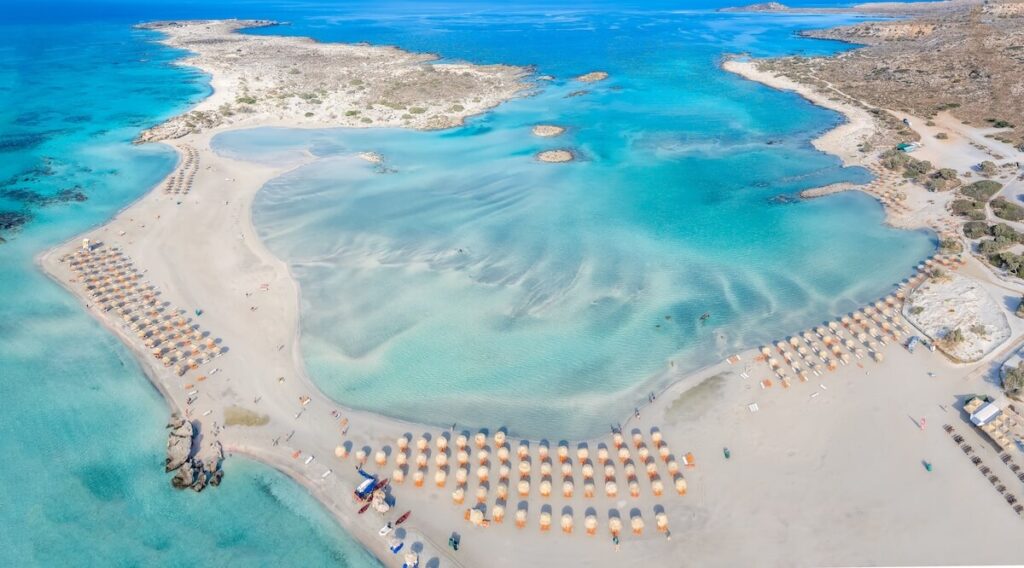
One of the most famous beaches in Crete, Elafonisi is renowned for its unique beauty. Approximately 80 kilometers from the city of Chania, Elafonisi is essentially an oblong peninsula.
Spread across a wide area, it features pink sand dunes lined with sea daffodils and shallow turquoise waters forming a natural lagoon. Its unique landscape earned it the status of a Natura 2000 protected area.
While the eastern side of Elafonisi has all the amenities of a world-class beach, you will find that it is easy to find secluded coves to swim in. That is where you can properly take in the wilderness of the landscape. Just beware of the (many) nudists there looking to do the same!
8. Vai palm forest

Vai’s claim to fame is that it is the largest palm forest in Europe. Covering a 250,000 square meter area, Vai is located 24 kilometers east of Sitia.
Vai’s one-of-a-kind scenery is composed of the 5000 palm trees that thrive there due to the area’s warm, dry climate and a magnificent Blue Flag white sand beach. Seeing a photo of Vai, you could easily be fooled into thinking you’re looking at a tropical Caribbean location!
The forest also happens to be a great place for birdwatchers, as it is home to many species of migrating birds that stop there on their journey to and from Africa.
9. Samaria gorge

Crete is famous for being home to the longest gorge in Europe, the Samaria gorge.
The 16-kilometer-long gorge is located in Lefka Ori (White Mountains) National Park in the Chania prefecture. Hiking through the gorge is a challenging task that normally takes between 5 and 8 hours to complete, depending on one’s levels of fitness.
I once went there on a school trip and, on the morning the hike through Samaria gorge was scheduled, half of my classmates pretended to be sick in order to get out of it. Luckily, our teachers saw right through our lazy teenager lies, so we got to be rewarded by the gorge’s stunning natural beauty!
10. Gavdos

Crete is not only known for what’s on the main island, but also for what’s around it. This includes Gavdos, a tiny island 22 nautical miles away from Sfakia.
Gavdos is the southernmost part of Europe and is known for its secluded, almost mystical, vibes. While the island only has 100 permanent residents, it is a destination that is famous for welcoming rebels and outcasts.
This started with it being the place exiled Greek freedom fighters were sent to. Later on, in 1986, Russian nuclear scientists looking for a peaceful life claimed it as their new home post-Chernobyl.
Today, the 10-kilometer-long island is a favorite for travelers who are into alternative, off-the-beaten track locations.
11. Psiloritis

While this may come as a surprise to the uninitiated, Crete is not just beaches and sun. It is also famous for its mountains. In particular, it is known for Mount Ida or Psiloritis, which sits at a whopping 2456 meters in the center of the island.
The Psiloritis mountain range extends from Rethymno to Heraklion. It has been recognized as a UNESCO Global Geopark and is part of the E4 European long-distance paths. Psiloritis is a great source of pride for Cretans and it is easy to see why.
Not only is it home to several picturesque villages, but it features gorges and caves that were used as a refuge by Greek fighters in their bid for freedom from occupiers.
12. Minotaur

Even if you are not a huge mythology fan, you will have definitely heard of the Minotaur.
Legend has it that this half-human/half-bull creature lived in the labyrinth of the palace of Knossos. Not only was the Minotaur supposed to be invincible, but also the labyrinth was created in such a way that nobody who entered it could ever exit.
The story of Theseus defeating the Minotaur and managing to exit the labyrinth with the help of a thread is one of the most famous ones in Greek mythology.
However, I would personally recommend diving even deeper into this legend. The longer story of the Minotaur is so convoluted and has so many twists and turns that it will blow your mind!
13. Diktaion cave

Crete is famous for being the birthplace of the leader of the Greek gods, Zeus. It is believed that Zeus was born in one of the island’s 3000 caves, Diktaion, in East Crete. Located at an altitude of 1025 meters on Mount Dicte, the cave is also known as Psychro due to its proximity to the Psychro village.
Archaeologists have found evidence of human presence in the cave that dates back to Neolithic times. Specifically, they found the remains of an altar and various offerings to Zeus, which included olive oil, honey, wine, and animal sacrifices.
Today, the cave is visited by many people for its history and impressive stalactite formats. If you’re lucky, you might even catch a glimpse of a long-eared bat there!
14. Mantinades

Mantinades (plural for “mantinada” in Greek) are one of the main things that define the island of Crete. The word “mantinades” may not instantly ring a bell, but if you have ever been to Crete, you will definitely recognize them.
They are 15-syllable rhyming couplets, i.e. very short folk songs. Inspired by Venetian poetry in the 15th century, Cretans decided to create their own unique form of expression. Mantinades are used to express all sorts of emotions, from joy to sorrow and love.
They are not officially recorded so, their only way of living on is by word-of-mouth. This makes their preservation a particularly important task for the people of Crete.
15. Spinalonga

Spinalonga, also known as the “leper island”, is an islet located near Elounda in East Crete. The tiny island has a long (if rather unsavory) history since it used to be the place that lepers from all over Greece were sent to isolate… essentially, an old-time Covid quarantine hotel!
Spinalonga’s strategic location meant that it was also very useful as a defense base and fortress for Elounda’s harbor and many important battles took place there.
Today, the picturesque rocky island is very popular with tourists and makes a great destination for a historical day trip.
16. Malia

Crete is a beautiful place with a rich history, but that doesn’t mean it’s not also great for partying. In fact (and probably much to the chagrin of locals), the village of Malia is famous for being party central.
35 kilometers east of Heraklion, it is considered by many to be the ultimate location for a “three S holiday” (sand, sea, and sex)! In the summer, Malia is swarmed by nightlife aficionados who are drawn to it for its dozens of bars and nightclubs that stay open throughout the night and until late in the morning.
While it doesn’t have the reputation for being the classiest of places, it is cheap and definitely has a charming appeal.
Wrap-up

As one would expect from the country’s largest island, Crete has a lot to offer. Whether you are looking for ancient ruins, fascinating cultural traditions, soft sand beaches or to hike in stunning natural surroundings, this is the place to go!