
I recently spent a whole month backpacking around Tunisia with my husband, Alex. It was an impromptu trip—we booked our flight tickets just one week before our departure. We have plenty of travel plans for the upcoming year ahead, so it was essential for us to keep to the lowest budget possible.
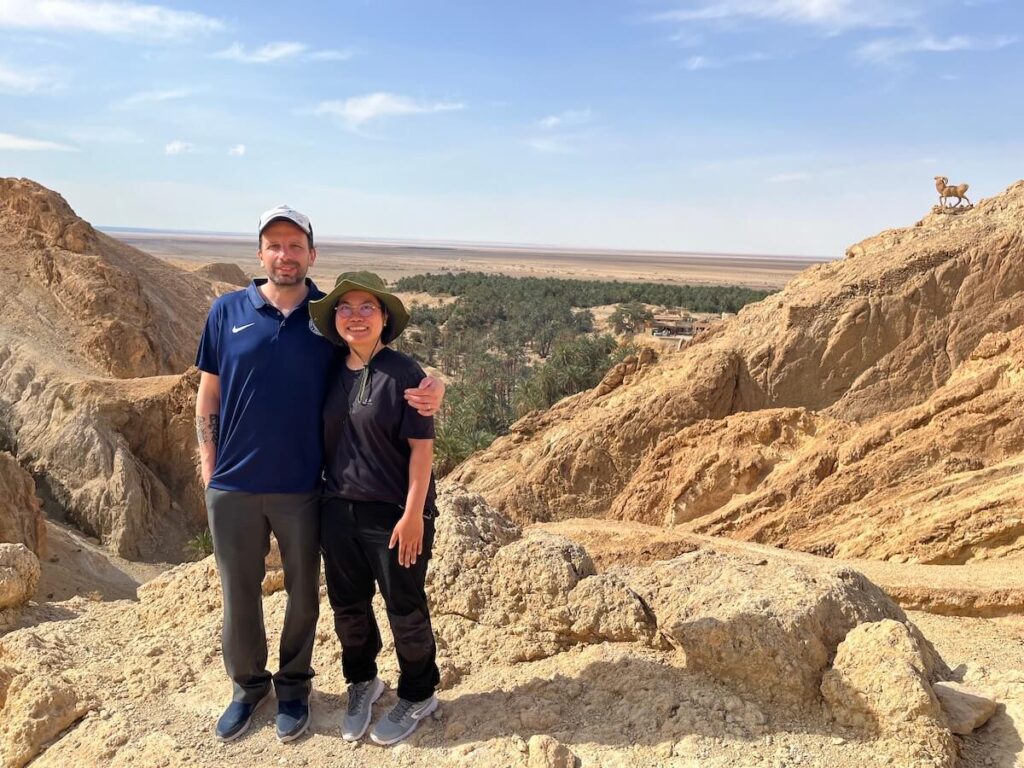
To be honest, we didn’t know much about Tunisia prior to our arrival. To plan my trip, I joined various Facebook groups to ask for recommendations on places to visit. Then, I activated my long-dead Couchsurfing account to get information directly from locals.
The main goal for this Tunisia vacation is pretty simple: to eat good food and to meet new people.

During the course of my trip, I realized that Tunisia is an affordable destination but traveling around the country on a budget is… not as simple as it seems. Tunisia is known as a destination for all-inclusive vacations in fancy resorts rather than for independent explorations, which is my style of travel. That’s why I decided to sit down and write this article.
If you’re planning to visit Tunisia in the same manner as I did—independently and on a small budget—this list of tips should come in handy!
Table of Contents
1. Use Kiwi.com to search for flights
With the help of Kiwi.com, I scored return flight tickets comprising four flights with three airlines (easyJet, Tunisair, and Nouvelair) for around 200 Euros per person from Brest, France.
I’m a big fan of Kiwi.com because it has unique filters that aren’t available on many other flight search engines.

For example, if you are flexible with your travel period and duration, you can set a range of dates for both your departure and return flights to find the cheapest option.
Also, instead of choosing “Tunis-Carthage International Airport” as your destination, you can simply type “Tunisia” to include all airports in the country. It was thanks to this that I landed at the airport in Monastir and departed from the one in Tunis a month later.
2. Don’t rely on just Booking.com or Airbnb to find accommodation
Finding cheap and value-for-money accommodation in Tunisia through the usual channels like Booking.com and Airbnb proved to be a challenge.
For example, if I do a search for a room in Bizerte for next week on Booking.com, only 11 properties show up. The cheapest among them is an apartment for US$35 a night… with zero reviews. On Airbnb, listings start from US$30 onwards… and the thing is, many of them look pretty shabby.
I’m afraid it takes a little more effort to find budget hotels. What works for me is to pinch around Google Maps and browse through the hotels that pop up. Then, I’d ask a local friend to help me call the hotel, ask for the price, and make a reservation. It sounds troublesome but it’s easy and worthwhile to make Tunisian friends through Couchsurfing. (More on that later.)
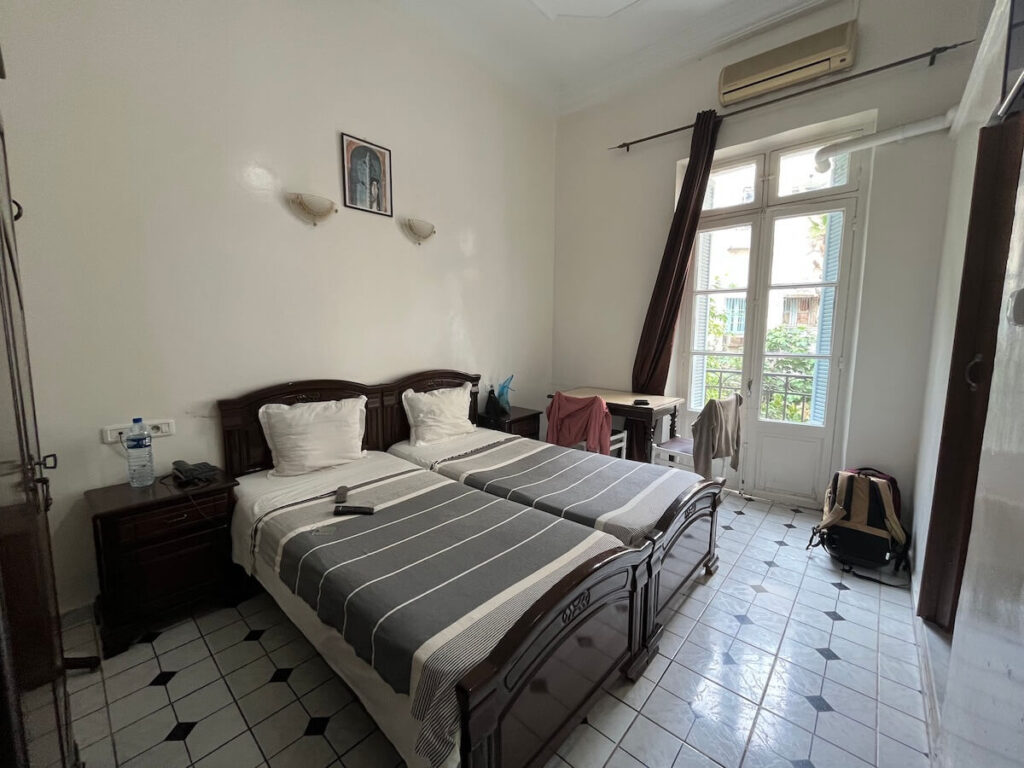
Here are the hotels I stayed in:
Location: Tunis
Hotel: Grand Hôtel de Paris
Price: 60 dinars (US$20) per night for 2 people
Review: This is a gem find! The room was spacious and clean. 100% recommended.
Location: Sousse
Hotel: Hotel Paris
Price: US$14 per night for 2 people
Review: Great for non-fussy travelers! My only complaint is the noisy location and hard pillows.
Location: Bizerte
Hotel: Hôtel De La Plage
Price: 30 dinars (US$10) per night per person
Review: The room was comfortable but the bathroom was in a terrible condition. I wouldn’t stay here again.

Here are two hotels that a friend has stayed in and recommended:
Location: Douz
Hotel: Hôtel 20 Mars
Price: 25 dinars (US$8) per night per person for a room with a shared bathroom
Review: It’s a good hotel!
Location: Gabes
Hotel: Maison d’hôtes Oasis de Mounira
Price: 40 dinars (US$13) per night per person for a room with a shared bathroom
Review: Located out of the city center but otherwise nice and cozy.
This is probably a good time to set your expectations straight about budget hotels in Tunisia. Please be mentally prepared to leave behind your modern comforts. In my experience, it’s usual to find musty blankets, worn-out furniture, broken appliances, non-functional wifi…

You might have better luck in dars, which are boutique hotels housed in traditional mansions and townhouses. These tend to be more expensive than hotels, but your stay turns into an experience, plus you’ll get a more intimate and familial atmosphere. A friend of mine recommends Dar Hkaiem in Hammam Sousse, which is a short taxi ride to the center of Sousse.
3. Consider sleeping in the youth centers
What about hostels, you ask? There are a handful of them, like the Nomads Hostel in Tunis, but in general, hostels aren’t common in Tunisia.
However, you can find youth centers (or maison des jeunes, as they are called in French) in several cities like Sousse and Sfax. As its name suggests, these youth centers are locations where activities for youths (eg. martial arts classes) are held.
Apart from activity spaces, they offer basic private rooms that are open for all—young or old, local or tourist. My husband and I slept in the youth center in Tozeur for 23 dinars (US$7.50) a night per person.
4. Connect with locals through Couchsurfing
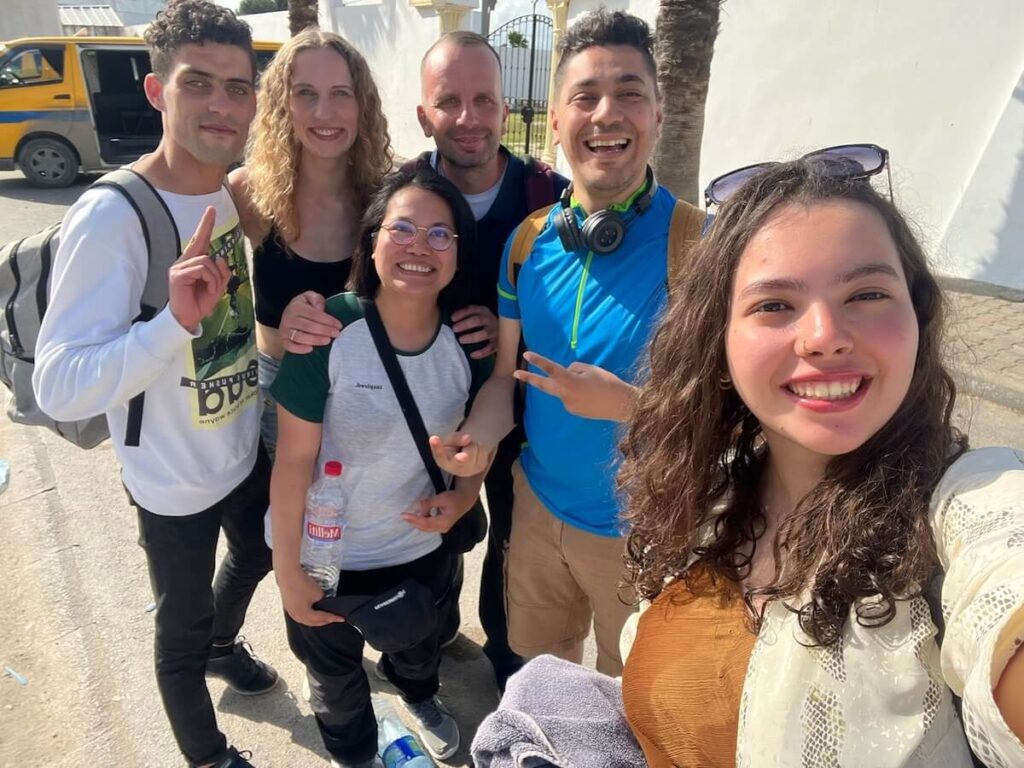
My trip wouldn’t have been the same without the Tunisian friends I made through Couchsurfing, so this point is one close to my heart.
In case you’re not familiar with Couchsurfing, it’s a platform that connects travelers with locals who are willing to host them at home or show them around the city. It’s a great way to experience the local culture in an authentic way.
Couchsurfing is based on the idea of trust and reciprocity. It should never simply be seen as a way to get free accommodation and tours. As a guest, you can show your appreciation to your host by paying for meals, doing the dishes, and things like that.


The Couchsurfing community isn’t as active in Tunisia as in some other countries (eg. Iran), but we had great luck with it nonetheless. We were invited to the homes of Amine in Mahdia, where we had great conversations into the night, and Khaoula in Jendouba, where we feasted on delicious home-cooked meals.
We also met up with many other locals throughout the country who shared a piece of their daily lives with us.
5. Take public transportation: louages, trains, or buses
Taking public transportation is an affordable way to travel from city to city in Tunisia.

The fastest mode of transport is the louage, which is a form of shared minibus taxi that can take up to eight passengers. At the louage station, you’ll be directed to the louage that is heading to your destination.
The louage leaves as soon as it fills up—if you’re lucky, you’re the last passenger to arrive. In my experience, louage drivers drive fast, making many heart-stopping overtakes of slower vehicles. You just have to put your faith in their driving skills.
To give you an idea of the prices, the one-hour louage ride from Bizerte to Tunis costs 6.5 dinars (US$2), while the three-hour louage ride from Sfax to Gafsa costs 17 dinars (US$5.50).
Alternatively, there are buses and trains, but their networks are less extensive and timings are more limited compared to louages.
6. Get your SIM card from Ooredoo

This is not much of a tip per se, but I thought it’d be helpful to give you some information on getting a SIM card in Tunisia. From what I heard, the two best operators are Ooredoo and Orange.
I went with Ooredoo just because I liked the sound of it. I popped into one of the many Ooredoo shops around the city to ask for a SIM card with data, and it was done within minutes. Just don’t forget to bring your passport!
You can find the rates for Ooredoo here, but here’s a quick summary:
- 2GB – 8 dinars (US$2.60)
- 25GB – 30 dinars (US$10)
- 55GB – 55 dinars (US$18)
7. Use the Bolt application in Tunis and Sousse
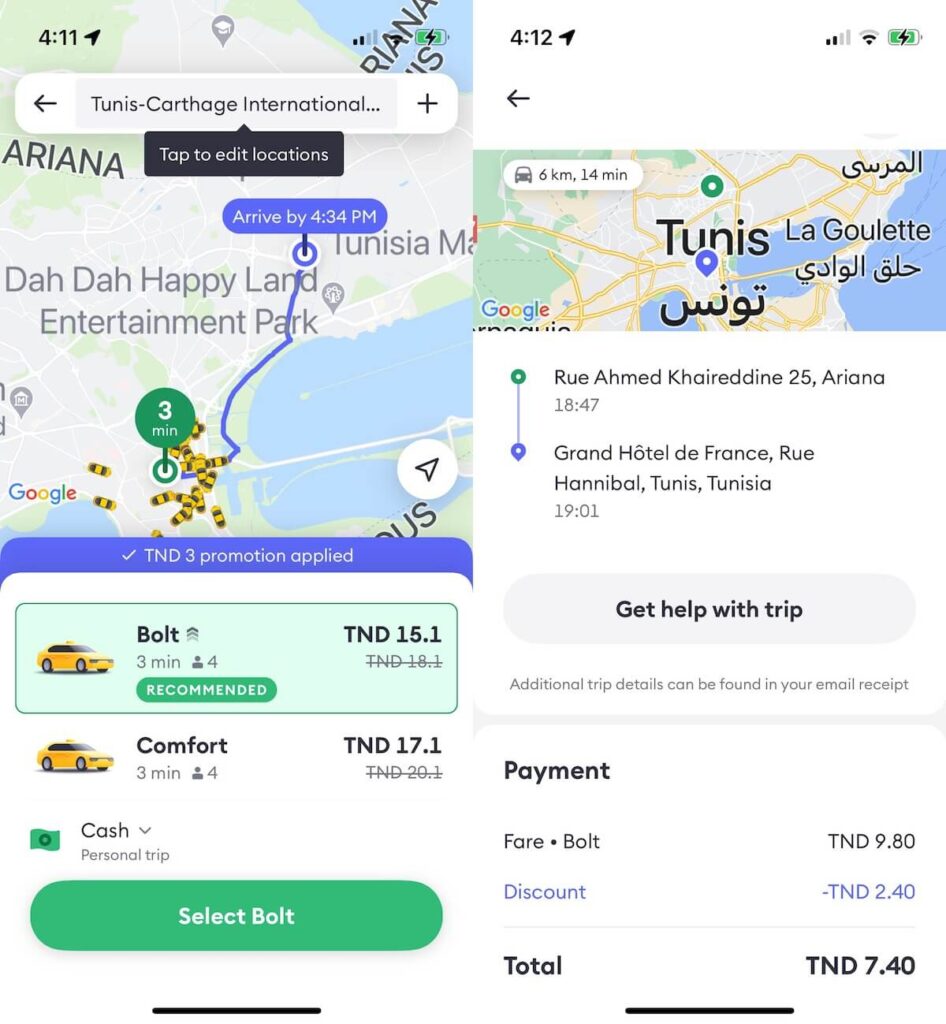
Ever wondered if there’s some kind of Uber in Tunisia? Well, there’s Bolt, which works in Tunis and Sousse.
While locals would say that Bolt is expensive (compared to regular taxis), I think it’s worth it for tourists for three reasons:
- You won’t get overcharged by the occasional unscrupulous taxi driver
- You don’t have to struggle to explain where you want to go (unless you speak Arabic or French)
- What’s expensive for the average local person might not be expensive for you
To elaborate on the last point, my 10-kilometer ride at 4 am from my hotel in the city center to Tunis–Carthage International Airport costs a whopping… 12.60 dinars (US$4).
8. Understand how taxis work

Taxis are a common mode of transportation within cities but the payment system varies depending on the city. I am lucky to be friends with Moez, a local Tunisian who supplied me with all this information I need to share with you.
In many cities, shared taxis take up to four passengers and the price is fixed per seat. In Mahdia, which is a small city, the price per seat is 1.1 dinars. In Sfax, it’s between 1 to 1.5 dinars depending on the destination. You can also negotiate with the taxi driver to take you directly to your destination by paying the price for four seats instead of one.
In Tunis and Sousse, there are also louages. As mentioned, these are large shared taxis. They depart from the louage station but you can wave them down on the streets. Once again, the price is fixed per seat. In Tunis, it’s between 1 to 2 dinars while in Sousse, it’s between 0.85 to 1.5 dinars depending on your destination.
Taxis that function with the meter are also common and available in most Tunisian cities. When the taxi meter isn’t available, you can settle on a price before hopping on. While most taxi drivers I’ve encountered are honest, there are always those who will happily ask for double the usual price because you are a tourist.
9. Eat where the locals eat
This is pretty duh but I thought I should mention it anyway. Your best bets for finding a good restaurant would be to ask a local or to keep an eye out for busy restaurants during mealtimes.
I have the tendency to search for well-reviewed food options on Google Maps, but this is not the best strategy for Tunisia. Locals don’t usually write reviews, so you might end up in an overpriced restaurant frequented by tourists who leave such reviews.

Food in Tunisia is considered cheap by Western standards. For a quick meal, you can opt for a sandwich for around 4 dinars (US$1.30).
However, I highly recommend trying more traditional dishes such as ojja, kafteji, molokhia, and of course, the famous couscous. In a restaurant where locals eat, you can easily enjoy a meal for two under 20 dinars (US$6.50) with drinks included.

The biggest splurge I had for a meal was at Bibichou Restaurant in Sousse, which is an excellent place for fresh seafood. This kamounia aux pulpes (octopus in cumin sauce) pictured above costs 24 dinars (US$7.80), but it was cooked perfectly and well worth the money.
10. Set aside a budget for tours
While doing your research for Tunisia, you have no doubt seen photos of beautiful waterfalls, canyons, salt lakes, ruins, and deserts. The thing is, many of these Instagram-worthy places are not very accessible by public transport. Therefore, you need to join a tour or have a vehicle.
The thing is, I’m not a fan of organized tours and I don’t like the idea of renting a car, so I found myself in a pickle while in the desert oasis of Tozeur.
After talking to locals, my husband and I cracked for a private excursion on a 4×4 vehicle. For the price of 250 dinars (US$81), the driver was supposed to take us to these spots:
- Chebika
- Tamerza
- Mides Canyon
- Ong Jmal
- …and the Sahara Desert

I said “supposed to” because we abandoned the tour at the very first stop, Chebika. On that day, the site was full of tourists and they were likely to be following the same route as us. Call us snobs, but after years of traveling, we lost the appetite for overly touristy experiences where everyone’s waiting for the crowds to clear for a picture that doesn’t reflect reality.
That said, I know that these places are a must-visit on many itineraries, so do set aside the budget for such tours.
11. Join some Facebook groups
Whenever I need up-to-date travel information, I normally head to Facebook groups where I can get answers from locals and other travelers.
Here are some that are catered for travelers in Tunisia:
I’d say that the last group is the best one. I’ve posted two questions in there and received over a hundred responses each time. However…. it’s in French. If you don’t mind doing some translating, then go for it!
So… is Tunisia cheap to visit?
I’d say that Tunisia is an affordable travel destination, especially in terms of food and transport. It’s also possible to find affordable accommodations but with a bit of effort. Your biggest expenses would be for the tours to visit attractions in the desert.

Alex and I spent a total of €1,245 for 28 days in Tunisia, which averages out to €45 (US$48) per day. (Note that we spent nine nights sleeping in the home of locals for free, but we did pay for our hosts’ meals when we can.)
With that rule of thumb, you can expect to spend around US$50 per day if you’re traveling as a couple or around US$30 per day if you’re traveling alone… if you have the same style of travel as me.
Wrap up
Tunisia offers a multitude of experiences without straining your wallet.
Personally, I think that the cuisine alone is enough to visit—we’re talking saucy dishes jam-packed with fragrant spices and served with harissa! If you’re into history, then you’ll be treated to a wealth of impressive sites such as the Roman amphitheater of El Jem.
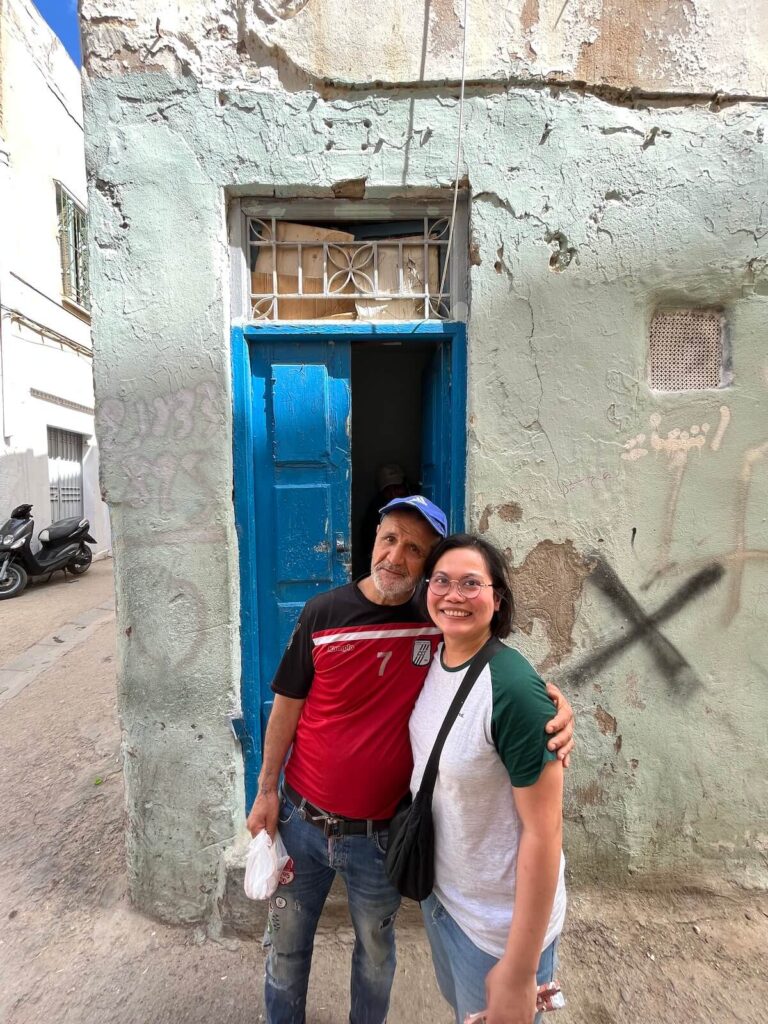
But ultimately, it’s the warmth and hospitality of the Tunisian people that will call you back for a second, third, or fourth trip. ❤️
