
It’s with great pleasure that today I’ll show you around my home country. I’ve prepared a two-week Brazil itinerary that will introduce you to all the colors, flavors, and sounds that the largest nation in South America is known for.

Let’s start off in Rio de Janeiro so Christ the Redeemer can bless our journey. We’ll then go on to discover beautiful colonial towns, pristine beaches, and restless cities before finishing our Brazilian odyssey at the heart of the Amazon Rainforest.
There’s just one thing you’ll need to think about: which souvenirs you’ll be bringing home!
Table of Contents
How to get around

Brazil is larger than the contiguous United States, so most of the time you’ll need to hop on a plane to go from one region to the next.
Rio and São Paulo, however, are separated by a mere 6-hour drive. And since Paraty stands right between the two, you can rely on buses, private transfers, or a rented car for the first part of your trip.
Subway lines reach the touristy areas of all the big cities you’ll be visiting (Rio, São Paulo, Salvador, and Brasília), yet only São Paulo has a comprehensive network.

Calling an Uber usually comes cheaper than hailing a cab if you need to go someplace that isn’t serviced by the subway. A 10- to 15-minute Uber ride will hardly cost more than $6.
By the way, in case you’re wondering how much money you need for 2 weeks in Brazil, I’m pretty sure $100 a day (plus accommodation and air tickets) will let you enjoy a very comfortable trip across the country.
Also read: Is Brazil Expensive to Visit? Your Guide to a Budget-Friendly Trip
Two-week Brazil itinerary: What first-timers can’t miss
Days 1-3: Rio de Janeiro
Where to stay: Copacabana Palace, where Hollywood stars have stayed for 100 years, or Guesthouse Bianca, a budget-friendly alternative in the quaint Santa Teresa district

Any Brazil 2-week itinerary just has to start in my hometown, the country’s most famous city. Rio de Janeiro boasts a one-of-a-kind landscape, warm weather year-round, impressive architecture, and delightful nightlife.
Let’s kick off our 3-day Rio trip by checking off its ultimate symbol: the Art Deco statue of Christ the Redeemer.
When you’re done soaking up the million-dollar views of the whole city, head to the Maracanã stadium (for decades the largest in the world). If you have the chance, come back for a match and you’ll learn what supporting is actually like.
Flamengo Park is probably the best place I can think of for an afternoon stroll. You’ll be quite close to the Sugarloaf, but you’ll have to take the cable car to reach the top. A hard choice follows: watching the sunset up there or over a cold beer at the Urca promenade.
For your second day in town, don’t miss the 200-year-old Botanical Garden or the neighboring (and picturesque) Lage Park. Afterward, you can stroll along the heart-shaped Rodrigo de Freitas Lagoon, then hit the quintessential Copacabana Beach.

Spend your afternoon relaxing on the equally iconic Ipanema Beach. By the end of the day, locals and visitors gather at the Arpoador Rock to clap for the sunset.
Downtown Rio is where you should go for your third day in town. Highlights here include the bold Museum of Tomorrow, designed by Santiago Calatrava, and the Royal Portuguese Cabinet of Reading, which is consistently ranked among the most stunning libraries in the world.
The São Bento Monastery, with its elaborate gilded interior, and the Olympic Boulevard along the city’s port are worth a stop as well.
A yellow streetcar will then take you up the hill to Santa Teresa, Rio’s artsiest and quaintest district. On your way back, check out the lovely Selarón Steps. Stick around for as many caipirinhas as you manage to drink — you’re now in Lapa, Rio’s infamous red light district.
Consider visiting Rio during Carnival, when you can enjoy the city-wide street parties during the day and watch the awe-inspiring samba school parade at night.
Days 4-5: Paraty
Where to stay: Sandi Hotel, a lovely townhouse in the middle of the cobbled city center

The town of Paraty was a sugarcane port in the colonial era. Ironically, the decadence that followed ultimately saved it: both its cobbled streets (which were designed to flood at high tide) and its white townhouses have stayed intact over the centuries.
If you want to find out more about Paraty’s rich history, a walking tour of the city center is the perfect option. Ask the guides where the best distilleries are and go try some cachaça, Brazil’s national liquor and a local specialty.

Paraty is on a dazzling and jagged stretch of coast where mangroves and green hills cut between golden sand beaches. But unless you hop on a schooner for a boat tour of the region, you won’t see much of all that beauty.
Paraty is also a wonderful spot for adventure travel. You can kayak through the mangroves or hike Sugarloaf Peak to see Saco do Mamanguá, Brazil’s only fjord, from above.
Days 6-7: São Paulo
Where to stay: Hotel Unique, a boldly designed and luxurious option with the most iconic rooftop in town, or the Hilton Garden Inn Rebouças to discover the bohemian Pinheiros neighborhood

Home to the biggest Italian, Japanese, Portuguese, and Lebanese diasporas on the planet, São Paulo feels almost like a tropical New York. With 30 million people living in the metropolitan area, Brazil’s largest city is astonishing and overwhelming — which is exactly why it’s so fascinating.
Start the day strolling along the city’s one and only main street, Paulista Avenue (above), where you’ll find world-class museums like the São Paulo Museum of Art (MASP) and the Moreira Salles Institute.
The best time to tour the avenue is on Sunday mornings, when it’s entirely car-free. While you’re at it, notice the colorful murals that pop up all over the place.

In the afternoon, relax at Ibirapuera Park, where locals flock to jog, picnic, or simply hang out in the sun. You won’t be too far from the hipster-chic Pinheiros and Vila Madalena districts, both dotted with trendy bars and tempting fusion restaurants.
On your second day in São Paulo, head to the city’s historic core. Certain parts of it are a bit sketchy, but at least a couple of landmarks are worth a visit. Check out the Farol Santander overlook on top of the Altino Arantes building, affectionately called Banespão (seen below).

Afterward, stop by leading museums like the Museum of the Portuguese Language and the Pinacoteca do Estado (a major painting gallery run by the state of São Paulo). The city has the largest chopper fleet on Earth, so you might as well do as the locals do and see it from a helicopter.
For lunch, you’ll have at least two equally delicious options. Every weekend, Liberdade, São Paulo’s Japantown, hosts a day-long street market where you can have authentic takoyaki and other delicacies.
Then you have the vast Municipal Market, where countless kinds of multicolored fruit are a few stalls away from huge bologna sandwiches and pastéis (deep-fried dumplings).
If you’re after some nighttime fun, hit Augusta Street in the Paulista Avenue region. This is the go-to place for a younger crowd looking for either loud music or more laid-back vibes — there’s something for everyone.
Day 8: Iguazu Falls
Where to stay: Vivaz Cataratas Hotel Resort; apart from being great value for money, it’s close to both the airport and the Falls
Located between Brazil and Argentina, the Iguazu Falls (or Iguaçu in Portuguese) are the largest waterfalls on the planet. In 2011, they were rightfully voted one of the world’s seven natural wonders.

Some Brazilians will wittingly tell you to visit the Argentinian falls so you can check the best views of the park — the ones overlooking the Brazilian section. Jokes aside, you should definitely cross the border to enjoy a thrilling boat adventure.
If that sounds like too much adventure, stick to the Brazilian side, where you’ll just have to hike an easy trail to reach the observation deck and take in the fantastic views.
Days 9-10: Salvador da Bahia
Where to stay: Fera Palace Hotel for a delightful experience right by the historic core or Zank by Toque Hotel in Rio Vermelho to enjoy the Bahian nightlife
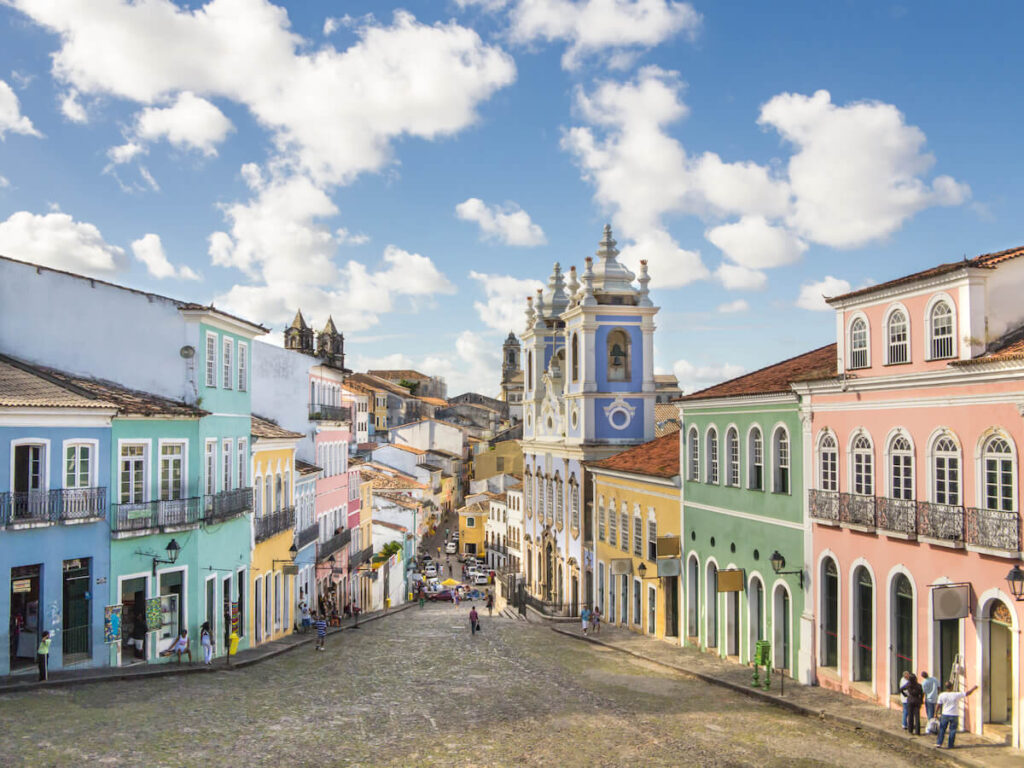
Salvador, in the northeastern state of Bahia, served as Brazil’s first capital for two centuries up to 1763 (when Rio took its place). The city was dubbed the Black Rome for its unique mix of lavish Baroque architecture and Afro-Brazilian culture, and as such its historic core became a UNESCO World Heritage Site in 1985.
Explore the cobbled streets around the Pelourinho, Salvador’s best-known square, then take the Art Deco Lacerda Elevator to reach the Lower City. Hunt for souvenirs at the Mercado Modelo and don’t forget to try acarajé, a black-eyed pea fritter that is stuffed with dried shrimp.
In the afternoon, head to the area around the Barra Lighthouse for some wholesome beach time. Though Farol da Barra Beach is a bit more spacious, the sunsets on Porto da Barra Beach are unforgettable.

For your second day, beach hopping is probably the best thing to do. You’ll find quieter beaches like Itapuã and Flamengo on the eastern side of town, but the islands within the Bay of All Saints are even more peaceful. You can take a ferry to Itaparica or book a day trip to Ilha dos Frades.
Come nightfall, don’t miss the Rio Vermelho district for the tastiest Bahian cuisine and the liveliest bars and clubs.
Day 11: Brasília
Where to stay: Brasília Palace Hotel, a classic of modern architecture, or B Hotel for its minimalist-chic vibes and the best views in town
Dedicated in 1960, Brasília was built in about 1,000 days in the geographical center of Brazil to replace Rio as the nation’s capital.
Famously shaped like an airplane to symbolize a country that dreamed of taking off, Brasília was listed as a UNESCO World Heritage Site in 1987 thanks to its lofty modern architecture.
Ironically, a few of its most prestigious buildings are temples, such as the Metropolitan Cathedral and the Dom Bosco Sanctuary.

You’ll see these and other landmarks on a bike tour of Brasília, which should be even more pleasant given the city is virtually flat and its roads are well-maintained.
Brasília is also noted for beautiful parks like Parque da Cidade Dona Sarah Kubitschek and Pontão do Lago Sul, where you can watch a breathtaking sunset over the capital’s vast blue skies.
Days 12-14: Amazon Rainforest

From Brasília, you can catch a direct flight to Manaus and land right at the heart of the jungle. This is where the dark waters of Negro River and the muddy waters of Solimões River meet to form the colossal Amazon River.
Distances are huge around here, especially since ferries and canoes are the default modes of transportation. This will of course allow you to discover the region more thoroughly.
Agencies offer amazing multiday trips through the rainforest. Some include swimming with pink dolphins and visiting indigenous communities along the river, while others will take you canoeing and fishing for deadly piranhas.
Conclusion

Bear in mind this two-week Brazil itinerary is supposed to cover just the basics. There’s a lot more you could (and should) discover if you visit again! If you have three weeks to spare, this 21-day Brazil itinerary is worth checking out.
Sights you shouldn’t miss on a second tour of the country include the town of Ouro Preto, a colonial gem in the southeastern state of Minas Gerais, and the archipelago of Fernando de Noronha (pictured above), home to a few of the most gorgeous beaches on Earth.
Now don’t forget to tell me in the comments which landmarks and places to visit in Brazil you can’t wait to explore! Why haven’t you booked your tickets yet, though?

How did you travel from Iguazu Falls to Salvador Bahia ? Is there a direct flight