
Having spent a year working in Cape Town, I would implore anyone to visit it.
Cape Town is famous for some of the world’s most breathtaking natural wonders, great beaches, and amazing wineries. But it’s also well-known for its history, cultural diversity, and checkered past. The combination of the city’s natural beauty and rich heritage is guaranteed to please even the most demanding of tourists.
So what is Cape Town known for? Let’s check out what makes the “Mother City” a bucket-list destination like no other!
Table of Contents
1. Table Mountain

Table Mountain is the most famous landmark in Cape Town. It is a mountain with a 3-kilometer flat plateau on the top, which makes it look like a – you guessed it – table. It makes for an impressive sight from almost anywhere in the city.
Table Mountain’s unique tabular shape is a result of the elements. Harsh winds and water erosion are responsible for exposing its many horizontal layers of sandstone.
If you happen to be in Cape Town during a South Easterly wind, you might be lucky enough to witness the “tablecloth”. This is a unique meteorological phenomenon where a layer of thin clouds appears to pour over the mountain, while the rest of the sky is clear.
2. Boulders Beach

Ask anyone, young or old, what they would most like to do in Cape Town and you’re likely to get the same answer. See the penguins on the beach, of course! Cape Town is famous for its African penguin colony that lives on Boulders beach, a sheltered cove protected from bad weather by giant rocks.
Penguins found their way there in the early 1980s and decided to stay due to the abundance of food available. Unfortunately, the climate has significantly changed since then, which means their food supply is now much more limited. While there are around 2000 penguins on Boulders Beach currently, they are on the verge of extinction.
A great way to spend the day in Cape Town is to walk around this beach’s wooden boardwalks and watch the penguins frolic in the sand!
3. Bo-Kaap

The aptly named Bo-Kaap, which is Afrikaans for “above the Cape”, is a neighborhood located up the slopes of Signal Hill, above the rest of the city.
If its name doesn’t ring a bell, then photos of it definitely will. Bo-Kaap is famous for the iconic colorful houses that line its streets, which would not look out of place in Havana, Cuba.
The most famous of them all is probably the green Auwal Mosque, which was the first mosque to be established in South Africa. It was built by a freed Black Muslim slave and represents Cape Muslims’ fight for their freedom to worship.
The area today is inhabited mostly by Cape Malays and is the place to head to for a mean curry.
4. Lion’s Head

If you were in Cape Town and didn’t take a selfie on the summit of Lion’s Head, were you even there? At 669 meters above sea level, Lion’s Head is a rocky peak not far from Table Mountain.
It is the most popular hiking destination in Cape Town and the best place to go for a panoramic view of the city. Part of Lion’s Head’s popularity is undoubtedly due to its size. It is smaller than Table Mountain and, therefore, takes less time to climb.
But don’t let the fact that it’s touristy stop you from visiting it. The screwtop trail to the top will reward you with its beauty. From silver trees to fynbos, Lion’s Head is stunning.
5. Robben Island
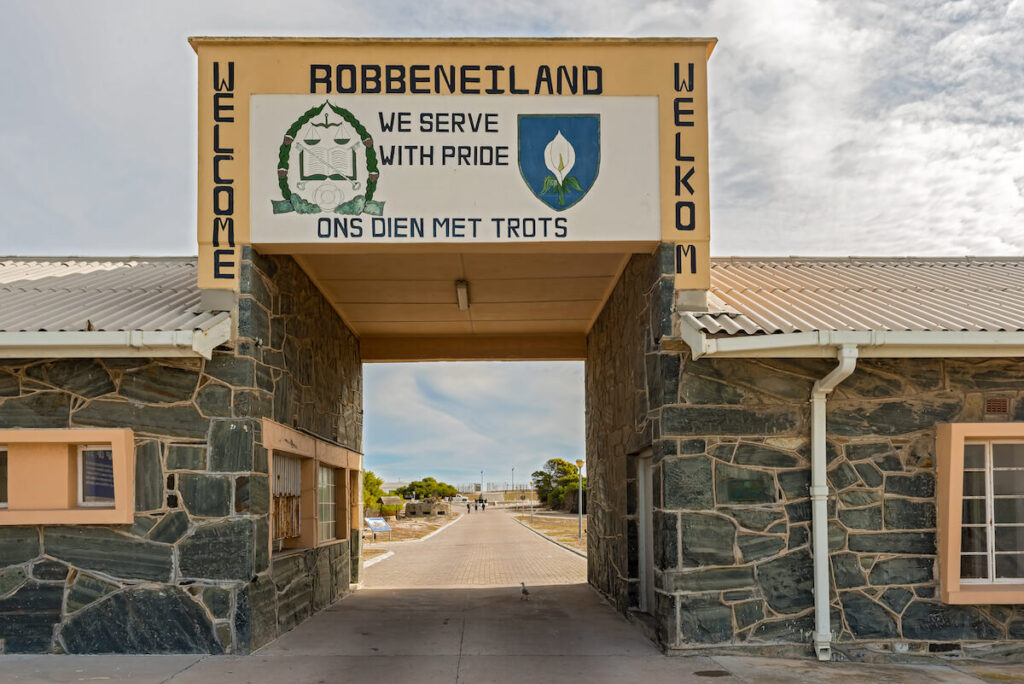
Cape Town is known for Robben Island, which is arguably one of the most historically significant destinations in Africa. 6 miles from the city’s coast, Robben Island is an island that, throughout history, was used as a prison and military base.
During the apartheid era, it was a detention center for political activists. Most notably, Nelson Mandela was held there for 18 years. Robben Island was notorious for its harsh conditions and brutal treatment of prisoners.
Today, it is a UNESCO World Heritage Site that serves as a symbol of the triumph of the human spirit over adversity. It is a reminder that despite the country’s troubled and painful past, South Africans can persevere and live as a united nation.
6. Kirstenbosch National Botanical Garden

One of Cape Town’s biggest attractions is Kirstenbosch. Sprawled over 28 hectares at the foot of Table Mountain, it features more than 7000 species of plants. These are spread over Kirstenbosch’s many different types of themed gardens, which include fragrance and medicinal ones.
However, the star of the show at Kirstenbosch is probably the “Boomslang”, a 130-meter-long centenary tree canopy walk. From there, you can take in the entirety of this natural wonder that is part of the Cape Floristic Region, a UNESCO World Heritage Site.
If you’re heading to Cape Town in the summer, i.e. November to March, make sure to check out Kirstenbosch’s concert schedule. Its amphitheater is one of the world’s most spectacular live music venues!
7. V & A Waterfront

The V & A Waterfront is a retail, dining, and entertainment area right by Cape Town’s working harbor.
Featuring more than 80 eateries, from upscale restaurants to trendy cafes and delis, it is always busy and favored by both foreign visitors and locals. There is an abundance of options for fun things to do at the V & A.
Not only does the area boast the massive Victoria Wharf shopping center, but it also has an aquarium, a skate park, an amphitheater for live performances, a modern art museum, and the iconic Cape Wheel. This giant Ferris wheel is located bang in the center of the Waterfront and is a tourist favorite for its 360 views of the city!
8. Camps Bay
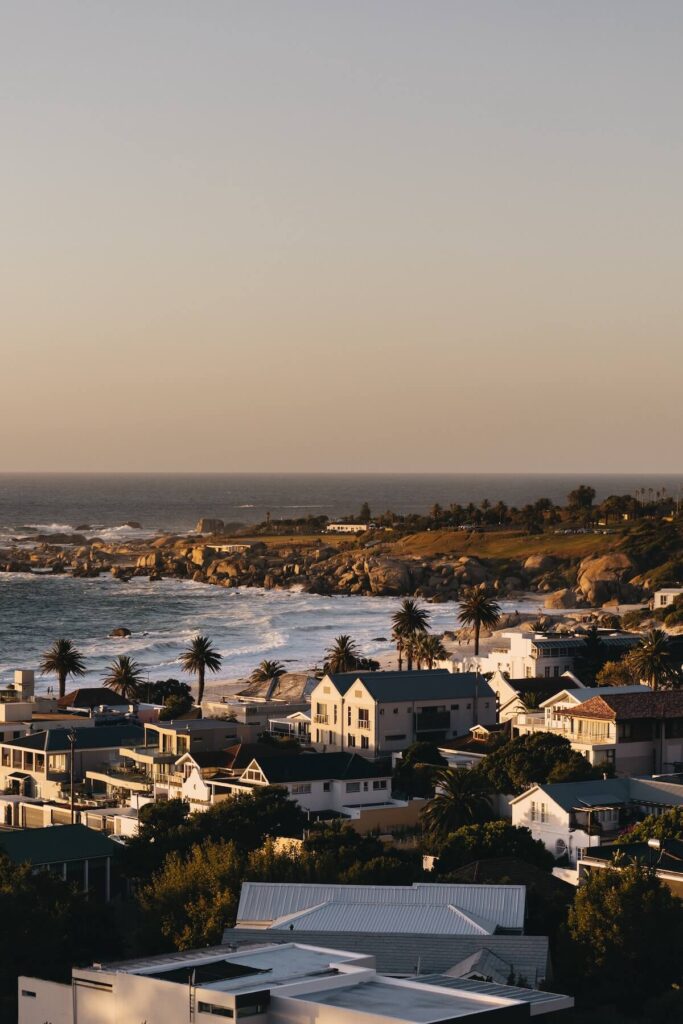
Camps Bay is an upmarket suburb of Cape Town, known for its glitz and glamor. Situated on the foot of the Twelve Apostles mountain range, Camps Bay is in a magnification location, overlooked by both Table Mountain and Lion’s Head.
The suburb’s main boulevard, Victoria Road, is lined with tall palm trees. Walking along it, on the left, you have Camps Bay’s iconic Blue Flag white-sand beach. On your right, is a string of fancy restaurants and cocktail bars, frequented by celebrities and big spenders.
While it is not cheap, a sundowner at Camps Bay’s iconic Caprice bar is a once-in-a-lifetime experience you will never forget!
9. False Bay

Another famous Cape Town bay is False Bay. Even though its vibes could not be any more different from Camps Bay, it has its own merits.
False Bay takes its name from the fact its discovery was essentially a mistake. Explorers mistook it for Table Bay, the bay that today forms the city’s harbor. An easy mistake to make, taking into consideration False Bay is the largest bay in South Africa!
Today, False Bay’s coastline is made up of a collection of quaint fishing villages, awesome surfing beaches, and lookout spots for whale watching. The coastal area’s gritty, small seatown vibes always seem to charm visitors.
10. Muizenberg

Muizenberg is one of the stars of False Bay. The beach-side town has the reputation of being the best place to learn to surf in Cape Town. Not only are the waves there consistent, but one of the oldest surf schools in the country, Gary’s Surf School, can be found there too.
If you are going there to surf, though, you should be aware of the shark alarms. These go off whenever a shark has been spotted so as to keep people out of the water. When I was last there, the shark alarms never seemed to stop!
Thankfully, there is plenty to do out of the water too. Muizenberg’s historical mile features great landmarks such as the Het Posthuys and Rhodes Cottage museums.
11. The Old Biscuit Mill
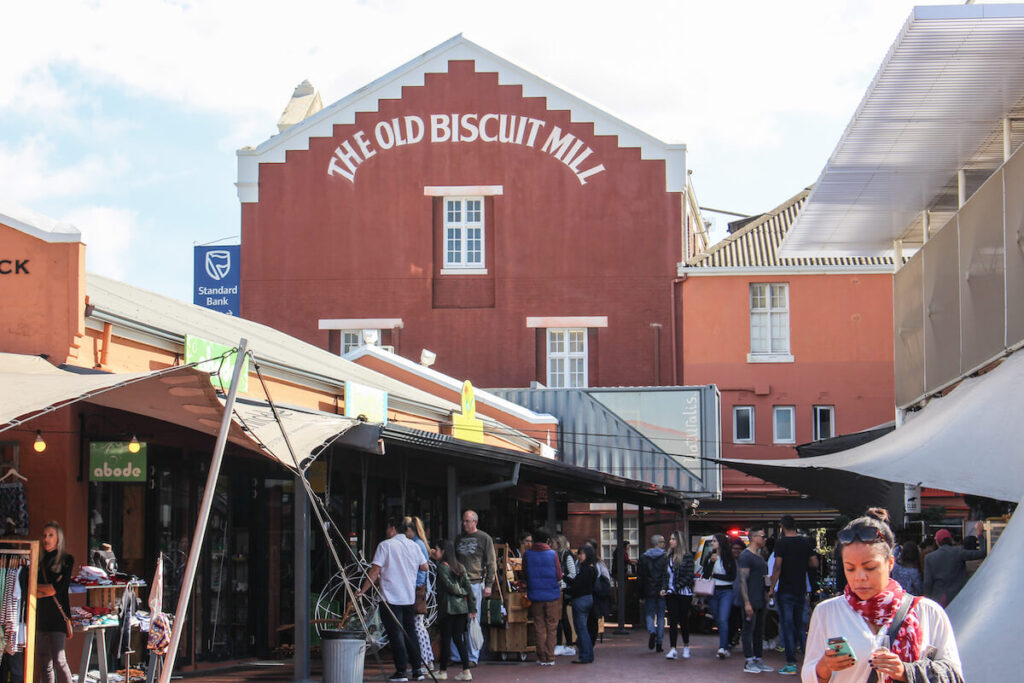
The Old Biscuit Mill, as its name would suggest, is an old mill that has been repurposed as a market.
If you head to this cool industrial setting in the Woodstock area of Cape Town on weekdays, you will find cute boutiques and artsy craft stores. On Saturdays, however, the Old Biscuit Mill houses the Neighbourgoods market. This is the most hip and happening event in town!
With stalls selling foods and drinks from all over the world, you can spend hours there, sampling gastronomic delights at the market’s shared tables. Just remember to head there with an empty stomach… and maybe plan to get an Uber home after trying all the craft beers and ciders!
12. Zeitz MOCAA

The Zeitz MOCAA (Museum of Contemporary Art Africa) has not been a fixture in Cape Town for a long time. It only opened in 2017. Yet, since then, it has managed to become one of the top spots to visit in the city.
The Zeitz is the first museum in Africa dedicated to contemporary art from Africa and its diaspora. Besides having a permanent collection, it also hosts a variety of curated exhibitions, including installations, sculpture, photography, and painting work.
Even if you are not an art fan, the Zeitz is worth visiting for its building alone. It is housed in a repurposed grain storage center, the interior of which has been artfully adapted to the museum’s needs and is a sight to see.
13. Long Street

Long Street is, as you can probably already guess from its name, a very long street in Cape Town.
It is considered to be the “heart” of the city for various reasons. Firstly, its location in the City Bowl part of Cape Town is super central. Secondly, as is evidenced by its many Victorian buildings, it is one of the oldest streets in the city. Thirdly, it is a busy place with a lot going on.
By day, it is where you would go to find cool bookstores, hip cafes and do some shopping. This is all very nice, but it’s by night that the place really comes alive. It is the city’s nightlife hub and an absolute party street. No visit to Cape Town is complete without a visit to Long Street’s Beerhouse pub or the iconic Waiting Room club.
14. Constantia Valley

Dating back to 1685, Groot Constantia is one of the oldest wine estates in South Africa, located in a verdant valley to the east of Table Mountain. The wine produced there is so renowned that it has even been written about by Jane Austen and Charles Dickens.
Today, it is still a working wine farm but also operates as a living museum. Visitors to Constantia can enjoy walking tours along the estate’s majestic oak-tree-lined avenues and well-preserved grand historic buildings and learn all about its rich heritage. They can also opt to do cellar tours and wine tastings.
A great idea for spending the day at Constantia is also to bring your own picnic, sit on the grass and enjoy the valley’s glorious atmosphere. Just be mindful of the baboons, which have been known to steal unattended food!
15. Cape of Good Hope

The Cape of Good Hope is a rocky cape best known for being located at the southernmost tip of South Africa’s Cape Peninsula.
Discovered in 1488 by the Portuguese, it was originally used as a trading hub and stop-over point for Europeans’ journeys to the Far East. Later on, after South Africa’s colonization by the British, it became a slave trade center.
Despite this checkered history, the Cape of Good Hope is today mostly remembered for being a graveyard of ships. There are over 1000 shipwrecks around the Cape of Good Hope, because of its notoriously rough seas and stormy weather. Today, it is a popular spot for diving and shipwreck exploration, as well as hiking, cycling, and other outdoor activities due to its rugged natural beauty.
16. Observatory

This may not be the first thing that comes to mind when discussing the question “What is Cape Town famous for?” but, in my opinion, it should be included in the list. Observatory, referred to as “Obs” by locals, is one of the best parts of Cape Town.
It is an artsy, bohemian haven that has some of Cape Town’s best theaters, galleries, cafes, and bars.
Once, as I was coming out of the train station in Observatory, I saw a young man climb out of the station’s bathroom window. Using this “alternative” exit, he was, in effect, bypassing the officers checking people’s tickets. Nonchalantly, he looked at me, shrugged, and said “That’s how we roll in Obs”. I’ve always thought that perfectly embodies the area’s spirit!
Summing up
Cape Town is one of the most spectacular places in the world. And the best part about it is that, even though it has a lot going for it, it’s developing in positive ways that make it an even better destination than it already is! I can’t wait to see what the future holds for this city.
What about you? What’s your favorite thing about the “Mother City”?