
You may find it unusual to dedicate an entire post to the most famous mountains in Brazil, but I’m committed to proving the topic is worthy of lots of attention: the country is home to countless stunning peaks and rock formations.

Made up of a very old landmass, Brazil lacks the snow-capped summits you’ll find across the western part of the Americas. In fact, all of its mountains are less than 10,000 feet tall.
Still, iconic sights like the Sugarloaf Mountain in Rio de Janeiro and less obvious ones like Morro do Pai Inácio in the northeastern state of Bahia should definitely make your bucket list.
Table of Contents
1. Sugarloaf Mountain

Sugarloaf Mountain is hands down Rio de Janeiro’s best-known attraction, at least where natural landmarks are concerned.
Its name, locally Pão de Açúcar references the shape refined sugar would typically be sold in up to the 19th century.
The 1280-foot gneiss peak is also famed for its cable car — the country’s first and the third-oldest on the planet, which takes visitors to the top of adjacent Morro da Urca, then to the Sugarloaf lookout.
The Sugarloaf emerged some 600 million years ago, when South America split off Africa. Today, mountaineers of all stripes flock to the 150 climbing itineraries within the Sugarloaf-Urca Hill complex.
2. Mount Roraima

Split across Venezuela, Guyana, and Brazil, Mount Roraima is a mesmerizing mesa rising above the neighboring savannas and rainforests.
About 5% of the mountain are within the Brazilian territory, yet one of its highest spots is the Tripoint summit, at 8,970 feet.
Due to its elevation and high rainfall, Mount Roraima is the habitat of many endemic species of reptiles, amphibians, and plants, including a bunch of carnivorous ones.
Climbers normally head to the mountain’s southern end on the Venezuelan side to reach the top. That’s a mildly easy hike (at least for experienced climbers) compared to the other access points.
3. Dedo de Deus

I was lucky to live under the so-called “Finger of God” for about two years before Rio’s irresistible hustle and bustle pulled me back in.
Dedo de Deus is the symbol of Teresópolis, a lovely mountain town approximately 60 miles from Rio de Janeiro. It also features prominently on the coat of arms and flag of Rio de Janeiro State.
The holy formation is the centerpiece of the Órgãos mountain range and national park, home to almost 50,000 acres of unspoiled rainforest.
The 5,550-foot-high peak was first climbed in 1912. That represented a major breakthrough for Brazilian mountaineers, given several foreigners had unsuccessfully tried to reach the top.
4. Morro do Pai Inácio

At 3,445 feet, Morro do Pai Inácio isn’t particularly famous for its height or for its shape. Instead, it’s made the rounds thanks to the breathtaking views you get from its flat top, as pictured above.
We’re at the center of Chapada Diamantina, a range of lush plateaus and canyons in the heart of Brazil’s northeast. The State of Bahia, where this gorgeous landmark is located, is widely revered across the country for its rich history, lively Afro-Brazilian culture, and delectable cuisine.
Every year, the Chapada area draws thousands of travelers in search of tons of exciting trekking and a refreshing dip in the region’s waterfalls. Quaint Lençóis and mystical Capão can be excellent launchpads for exploring the Chapada.
5. O Frade e a Freira
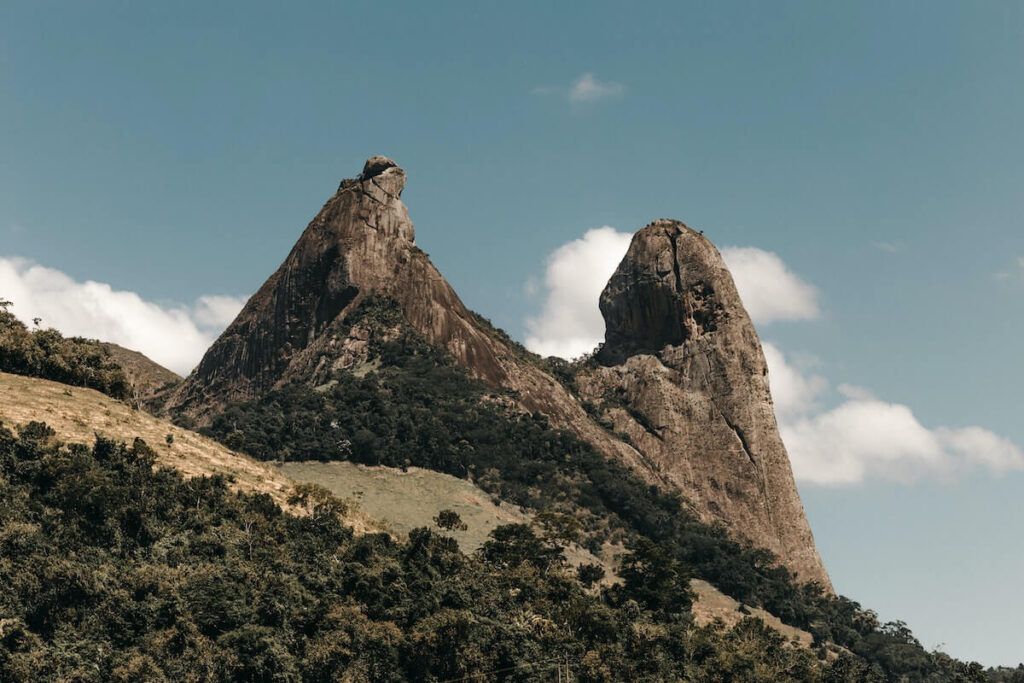
These one-of-a-kind rock formations are a mere 2,240 feet tall. Yet, since usually mountains need to be at least 1,000 feet tall to qualify as such, o Frade e a Freira do deserve a spot on our list.
O Frade e a Freira translates as “the friar and the nun”, which is perfect: the rocks look uncannily like a male and a female monastic facing each other.
These folks are hidden in southern Espírito Santo, which is squeezed between Rio de Janeiro and Bahia. Foreigners hardly venture out into these lands, which is indeed a shame.
They’re missing out on golden sand beaches, a peaceful countryside environment, and some of the best coffee and moqueca (i.e. fish stew) nationwide.
6. Pico da Neblina

At 9,825 feet, Brazil’s highest point rises prominently in the heart of the Amazon, in the Imeri range to be specific, less than half a mile from the Venezuelan border.
Its name means “Peak of the Fog”, as Pico da Neblina is constantly hidden under clouds. It remained unknown to Brazilians for centuries, until an airline pilot who was flying over the region in the 1950s discovered it at a rare moment when the peak was fully visible.
Pico da Neblina lies within a national park and an indigenous reservation, so all travelers are required to apply for a permit to enter the area. Hiring a local guide before climbing is mandatory.
7. Corcovado

Corcovado translates as “hunchback” in Portuguese, an allusion to the peak’s characteristic shape. While this 2,320-foot mountain could rank much higher, what really makes it famous isn’t exactly natural.
The mountain is of course renowned for the statue on top of it, i.e. Christ the Redeemer, one of the seven new wonders of the world. Back in the day, several locations were discussed, yet Corcovado was picked because it can be seen from basically all of the eastern half of the city.
Though a trail leads up to the top of Corcovado, riding the historic red train up to the Christ statues is one of Rio’s must-dos. The railroad through the jungle was dedicated in 1884 by then-Emperor Pedro II.
8. Pico das Agulhas Negras
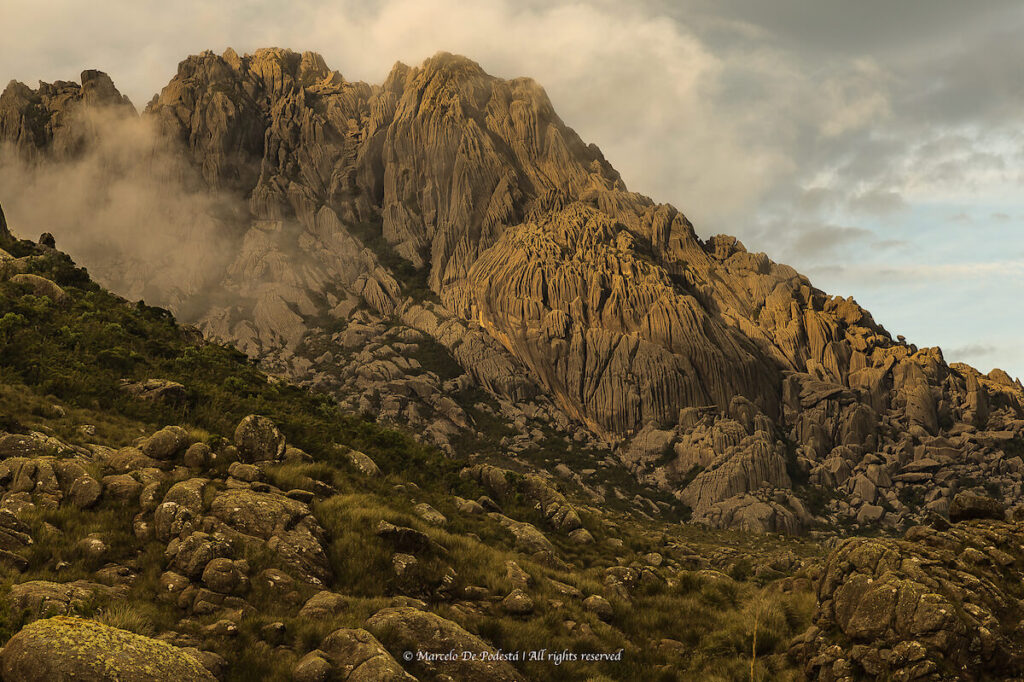
Pico das Agulhas Negras, literally the “peak of the black needles”, is the tallest mountain in the State of Rio de Janeiro, at 9,160 feet.
The summit is within Itatiaia National Park, which was created in 1937 as Brazil’s first-ever national park. The area’s rugged terrain often looks like an alien landscape.
Thanks to the park’s wide altitude range, it’s home to extremely diverse fauna and flora as well. If you’re visiting Brazil for more than 10 days, it would make an amazing weekend-long trip from Rio de Janeiro.
Trekking, mountaineering, and abseiling are popular activities around the peak throughout the year. But bear in mind that winters can be quite harsh by Brazilian standards. If you’re lucky, you can even witness some snowfall.
9. Pico Paraná

Let’s now head to the south of Brazil, specifically to the State of Paraná — where you can also visit Iguazu Falls. At 3,750 feet tall and an altitude of 6,160 feet, Pico Paraná is the highest mountain in the region.
This imposing monolith contains the tallest granite wall in Brazil, which makes it a sought-after destination among hardcore mountaineers.
Oddly, despite being less than 70 miles away from the State capital (the city of Curitiba), Pico Paraná would only be discovered in 1941 by German explorer Reinhard Maack.
The summit stands outside Superagui National Park, a UNESCO World Heritage Site where chunks of Brazil’s threatened mangroves and Atlantic rainforest are preserved.
10. Três Picos

Reaching an altitude of 7,760 feet, Três Picos, or Three Peaks, stands majestically within the State Park of the same name.
At 161,000 acres, the largest natural reservation in Rio de Janeiro spans five cities and features the highest biodiversity level in the State, as well as several endemic species.
Três Picos is adjacent to Órgãos Range National Park, alongside which it makes up an enormous Atlantic rainforest sanctuary.
With lots of trails, waterfalls, ponds, and fantastic lookouts for visitors to enjoy, Três Picos is a popular spot for two- and three-day trekking expeditions. You can easily depart from Rio, as the city is just 78 miles away from the park.
11. Morro da Igreja

Located within São Joaquim National Park in the southern State of Santa Catarina, this 5,980-foot-high peak is called Morro da Igreja, or “Church Hill”, apparently due to its resemblance to a Jesuit church.
This is one of the coldest places in Brazil and as such draws crowds looking to see some snow. It is, however, 125 miles away from Florianópolis, the state capital, which means foreign visitors may struggle to drop by.
That said, no hiking is necessary here. You’ll only need to drive for 10 miles from the highway to reach the overlook. From up there, you’ll see the famed Pedra Furada (or “Holed Stone”) pictured above and the whole valley below you.
12. Pedra Azul

Pedra Azul, or the “Blue Rock”, is known for changing color over 35 times a day. It can show hues of blue, yellow, and green, depending on how sunbeams reflect on the lichens that cover its surface.
This part of Espírito Santo State boasts a pleasant mountain climate year-round and draws couples and families to the top-notch hotels around Pedra Azul park. Though you won’t get to camp here, you can hike a series of easy trails.
The rock is 55 miles from Vitória, the beautiful capital of Espírito Santo, and can be a perfect weekend getaway if you’re traveling through southeastern Brazil.
13. Pico do Monte Negro

Pico Monte Negro is in a remote corner of Rio Grande do Sul, Brazil’s southernmost state. The peak is in effect a small elevation rising above the almost flawlessly flat Monte Negro plateau.
The summit’s trademark is the stark contrast between its lush vegetation and the steppe surrounding it.
From atop Pico Monte Negro, you’ll have the steep Monte Negro gorge at your feet. The mountain is on the opposite ridge of Aparados da Serra, a marvelous national park that boasts lush canyons and can be considered one of Brazil’s natural wonders.
Looking like a fusion of the northwestern United States and southeast Europe, this underrated part of the country is definitely worth exploring if you’re after vast expanses and endless peace.
14. Pico da Bandeira

Pico da Bandeira is called the “Flag Peak” because a Brazilian flag was placed on its top in the 19th century as per the Emperor’s request. Back in the day, the 9,485-foot mountain was thought to be the highest point in the country.
While it’s actually the third-tallest summit nationwide, it is indeed the highest point in southeastern Brazil. Many trails lead up to the top of Pico da Bandeira, which is considered an easy climb relative to its height.
The centerpiece of the Caparaó range is also the most topographically isolated spot in the nation, meaning it’s really far from any points of equal or higher elevation. What’s more, only 20 other summits on Earth are more isolated.
Wrap-up

Our list of famous mountains in Brazil features a few of the tallest peaks in the country, like Pico da Neblina and Pico da Bandeira, as well as rock formations with unique shapes, such as Dedo de Deus and Frade e a Freira.
The fact that all these summits are mildly short for international standards doesn’t take away from their impressive beauty. It should, however, encourage amateur trekkers and mountaineers to visit Brazil, as they won’t be challenged by snow and will likely find great weather ahead.